Compound Probability Worksheets
Free printable compound probability worksheets: find the probability of two events on a pair of spinners, and count all the outcomes. With an answer key.
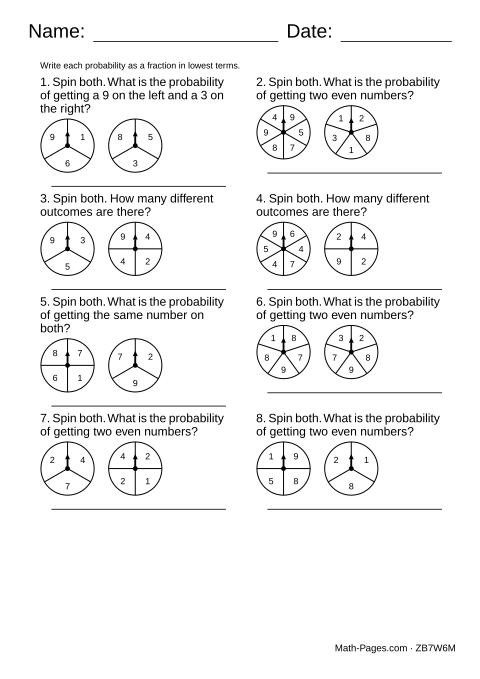
Each problem draws two small spinners side by side, each cut into equal sections with a number in every one, and asks about spinning both. A compound event is two events together: a 2 on the left and a 3 on the right, two even numbers, or the same number on both.
Every outcome is one section of the left spinner paired with one section of the right, so the outcomes number the two section counts multiplied: a spinner with 4 sections and one with 6 give 4 × 6 = 24. The probability of an event is the outcomes where it happens over all of them. If 2 of the 4 sections on the left are even and 3 of the 6 on the right, two even numbers can happen in 2 × 3 = 6 of the 24 outcomes, which is 1/4 in lowest terms.
About one question in three asks only how many different outcomes there are, and the answer to that is a whole number. The rest ask for a fraction in lowest terms, and say so at the top of the page. Each spinner has 3 to 6 sections, numbered 1 to 9, and the numbers can repeat. Listing every outcome in a table or tree diagram is a good way to see them, but a drawing is not something an answer key can mark, so the sheets ask how many there are instead.
What this worksheet covers
- Count the outcomes of two spinners by multiplying their section counts
- Find the probability of a compound event as a fraction in lowest terms
Common Core standards
- 7.SP.C.8a Understand that the probability of a compound event is the fraction of outcomes in the sample space for which the compound event occurs.
- 7.SP.C.8b Represent sample spaces for compound events and identify the outcomes that make up an event.
Frequently asked questions
What is a compound event?
An event made of two parts, such as an even number on one spinner and an even number on the other. Its probability is the number of outcomes where both parts happen, over the number of outcomes in all.
How do you count all the outcomes of two spinners?
Multiply the number of sections on one by the number on the other. Each section of the first spinner can pair with each section of the second, so spinners with 3 and 5 sections have 3 × 5 = 15 outcomes.
How do you find the probability of the same number on both spinners?
Count the pairs of sections that carry the same number, and divide by all the outcomes. If one spinner is numbered 1, 2, 3 and the other 2, 3, 4, then the pairs 2 and 2, and 3 and 3, match: 2 of 3 × 3 = 9 outcomes, so the probability is 2/9.
Does it matter which spinner a number is on?
Yes. A 2 on the left and a 3 on the right is a different outcome from a 3 on the left and a 2 on the right, and each counts separately. That is why the questions say which side each number is on, and why spinners with 4 and 6 sections make 24 outcomes, not 10.