Missing Number Multiplication and Division
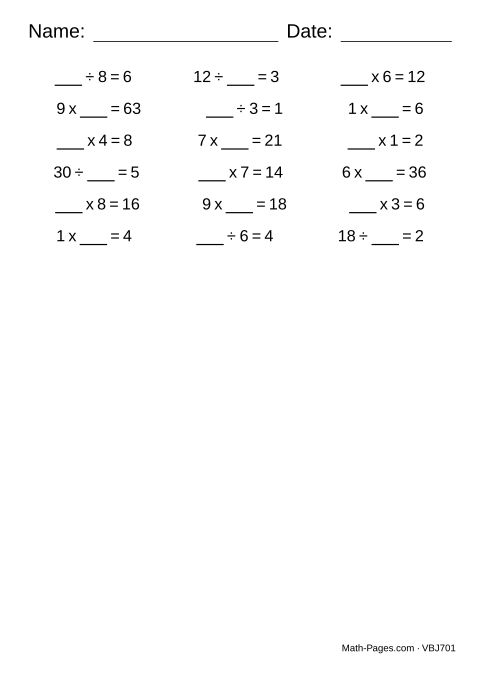
Free printable missing factor and missing number division worksheets. Problems like 6 x __ = 42 and __ ÷ 3 = 8, with an answer key.
Twenty problems a sheet, multiplication and division mixed, each with a box for the missing number: 6 x ___ = 42, or ___ ÷ 3 = 8. The blank alternates between the two operands so the page keeps switching which way the arithmetic has to run.
This is the multiplication counterpart of missing addends. A student who knows 6 x 7 = 42 but hesitates on 6 x ___ = 42 is treating division as unrelated rote rather than as multiplication undone. Every division problem here is built from a multiplication fact, so the missing number is always whole.
What this worksheet covers
- Find the unknown factor in a multiplication equation
- Find a missing dividend or divisor in a division equation
Common Core standards
- 3.OA.A.4 Find the unknown whole number in a multiplication or division equation.
- 3.OA.B.6 Understand division as an unknown-factor problem.
Frequently asked questions
What is a missing factor?
The number missing from a multiplication sentence - the box in 6 x ___ = 42. Finding it is the division 42 / 6, which is why practising it this way ties the two operations together.
What grade is this for?
Third and fourth grade, as the times tables become automatic and division is introduced as their inverse.
Will the division problems come out even?
Yes. Each one is generated from a whole multiplication fact, so the missing number is always a whole number with no remainder.
Does the key show the missing number?
Yes. Tick Answer key and every equation prints complete, with the number from the box filled in.