Proportional Relationships
Free printable proportional relationships worksheets. Is a table of x and y proportional? Find k, write y = kx, fill in blanks. With answer key.
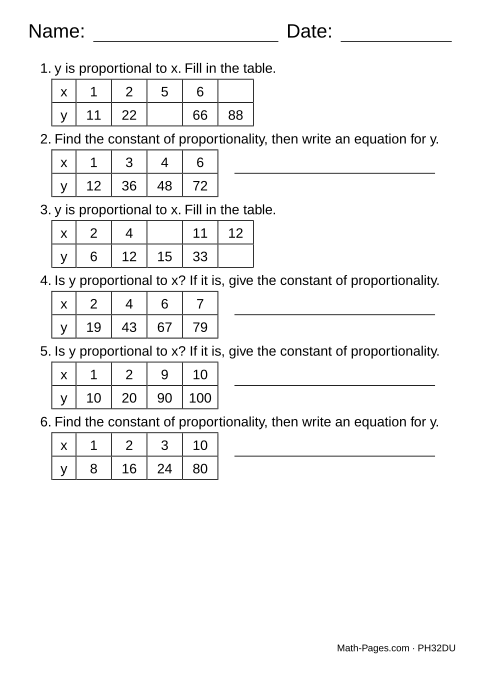
Every question is a table of x and y values. Some ask whether y is proportional to x and, if it is, for the constant of proportionality; some ask for the constant and an equation, like y = 4x; and some leave two cells blank to fill in.
A table is proportional when y ÷ x is the same in every column. The tables that are not proportional go up by a steady step, so they look orderly, but the ratios change: with x = 1, 2, 3 and y = 5, 8, 11, the first column gives 5 and the second gives 4. Steady is not the same as proportional.
Each page deals the three questions evenly, and splits its yes and no tables as evenly as the count allows, so neither answer is a safe guess. The constant is always a whole number from 2 to 12.
What this worksheet covers
- Decide whether a table shows a proportional relationship
- Find the constant of proportionality from a table
- Write an equation of the form y = kx
Common Core standards
- 7.RP.A.2a Decide whether two quantities are in a proportional relationship by testing for equivalent ratios in a table.
- 7.RP.A.2b Identify the constant of proportionality (unit rate) in tables.
- 7.RP.A.2c Represent proportional relationships by equations.
Frequently asked questions
How do you tell whether a table is proportional?
Divide y by x in every column. If every column gives the same number, the table is proportional and that number is the constant of proportionality, k. With x = 2, 3, 5 and y = 8, 12, 20, each column gives 4, so k = 4 and y = 4x.
Why can a table that goes up steadily still fail?
Because going up by the same amount is a different pattern from multiplying by the same amount. With x = 1, 2, 3 and y = 5, 8, 11, y rises by 3 each time, but 5 ÷ 1 = 5 and 8 ÷ 2 = 4, so the ratios differ and the table is not proportional.
What does the constant of proportionality mean?
It is the value of y when x is 1, and how much y grows for each step of 1 in x. If x = 3 gives y = 12, then k = 12 ÷ 3 = 4, and x = 1 would give y = 4.
How do you fill in the missing values?
Find k from a column that is complete, then multiply for a missing y and divide for a missing x. If x = 3 gives y = 12, then k = 4: a column with x = 7 has y = 7 × 4 = 28, and a column with y = 20 has x = 20 ÷ 4 = 5.
What grade are proportional relationships?
Seventh grade, standard 7.RP.A.2. These sheets use tables; graphs of proportional relationships, and equations or word descriptions as the starting point, are not on them.