Adding and Subtracting Integers
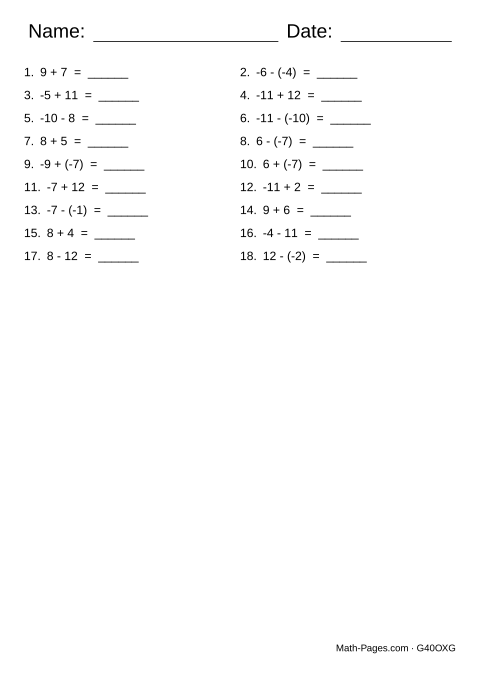
Free printable adding and subtracting integers worksheets. Signed whole numbers on one line - 18 + (-12), -9 - (-19) - with an answer key.
Every problem is two signed whole numbers with a plus or a minus between them: 18 + (-12), -19 - 13, 8 - (-19), -14 - 15. Both operands can be negative and so can the answer, which is what separates this from ordinary addition and subtraction.
This is the part of integers students find hardest, because two rules are running at once: what the sign of each number means, and what subtracting a negative does. The sheet mixes all four combinations rather than grouping them, so a student has to decide which case each problem is instead of repeating one move down the page.
What this worksheet covers
- Add and subtract positive and negative whole numbers
- Rewrite subtracting a negative as adding
Common Core standards
- 7.NS.A.1 Add and subtract rational numbers, including negative numbers.
Frequently asked questions
How do you subtract a negative number?
Subtracting a negative is the same as adding: 8 - (-19) is 8 + 19, which is 27. It is the single rule most worth practising until it is automatic, and roughly a quarter of the problems on each sheet are that case.
What is the rule for adding integers?
Same signs, add the magnitudes and keep the sign. Different signs, subtract the smaller magnitude from the larger and take the sign of the larger: 10 + (-18) is -8, because 18 is bigger than 10 and it is the negative one.
Are the answers ever negative?
Often. -14 - 15 is -29. A sheet where every answer came out positive would be hiding the thing it is meant to teach.
What grade is this?
Seventh grade, and the end of sixth. Sixth grade meets negative numbers and orders them; adding and subtracting them is the seventh-grade skill.