Multiplying and Dividing Integers
Free printable multiplying and dividing integers worksheets. Signed products and exact quotients - -11 × (-6), 144 ÷ (-12) - with an answer key.
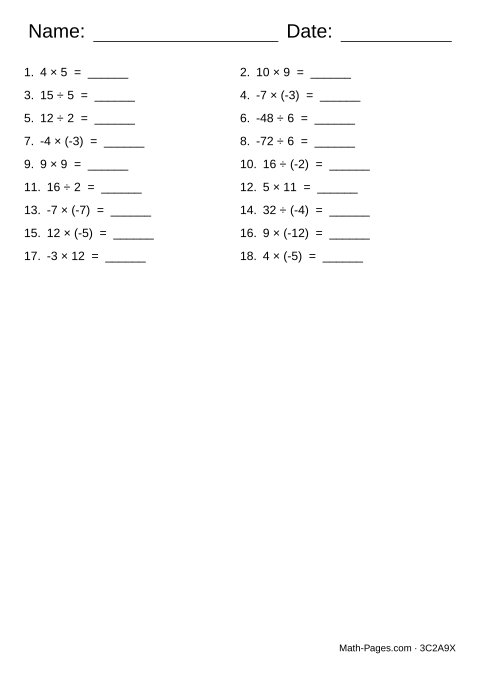
Signed products and quotients, one to a line: -5 × 11, -11 × (-6), 144 ÷ (-12). Every division comes out exactly - the problems are built backwards from the divisor and the answer - so a student is never left with a remainder on top of the sign rule.
Nothing here is multiplied or divided by 1. A problem like 12 × (-1) tests whether a student knows the sign rule and nothing else, and a page of them looks like practice without being any.
What this worksheet covers
- Multiply and divide positive and negative whole numbers
- Work out the sign of a product or quotient
Common Core standards
- 7.NS.A.2 Multiply and divide rational numbers, including negative numbers.
Frequently asked questions
What are the sign rules for multiplying integers?
Two signs the same gives a positive answer; two different signs gives a negative one. -11 × (-6) is 66, and -5 × 11 is -55. Division follows exactly the same rule.
Do the divisions come out evenly?
Always. Each division problem is built from a divisor and an answer and then multiplied out, so the dividend is a multiple of the divisor. Remainders and signs at the same time is two lessons.
Why are the dividends so large?
Because a dividend is a product: 144 ÷ (-12) has a two-digit answer of -12. The Largest number setting bounds the numbers a problem is built from, not the ones that come out of building it.
What grade is this?
Seventh grade. It usually follows adding and subtracting integers, which is the harder of the two despite looking simpler.