Fractions on a Number Line
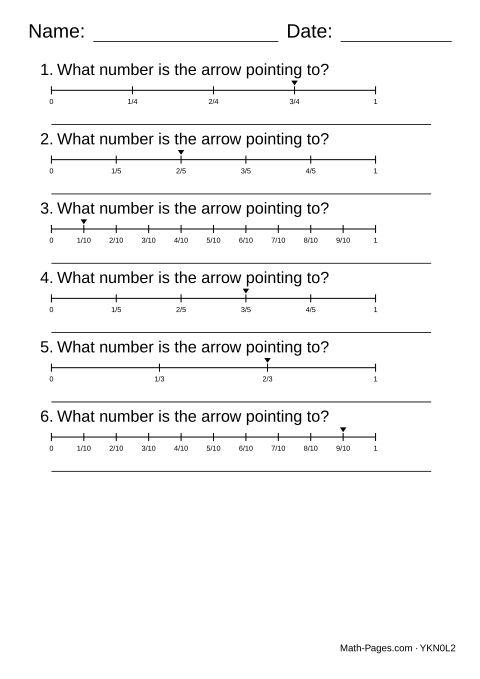
Free printable fractions on a number line worksheets. Read the fraction an arrow points to, on lines divided into thirds through tenths.
Every line runs from 0 to 1, divided into equal parts - thirds, quarters, fifths, sixths, eighths or tenths - with every tick labelled as a fraction. An arrow sits over one of them, and the question is which fraction that is.
This is where a fraction stops being a piece of a pizza and becomes a number with a place. A student who can shade three quarters of a circle but cannot find 3/4 on a line has the first idea and not the second, and the second is the one the rest of fractions is built on.
What this worksheet covers
- Name a fraction from its position between 0 and 1
- Count equal parts along a number line
Common Core standards
- 3.NF.A.2 Understand a fraction as a number on the number line.
Try it on a number line
Move the point along the line, or hop right and left from it, and the line writes the number sentence for each hop.
Frequently asked questions
Why put fractions on a number line at all?
Because it is what makes a fraction a number rather than a shape. Once 3/4 has a position, comparing it to 2/3 is looking at which is further right, and adding fractions is moving along a line.
What denominators do these use?
Thirds, quarters, fifths, sixths, eighths and tenths. Halves are left out - a line with one tick in the middle does not give a student much to read.
Are the fractions simplified?
No. On a line divided into sixths, the third tick is written 3/6, because that is the tick it is. Simplifying is a different question and our simplifying fractions worksheets ask it.
What grade is this?
Third grade - it is Common Core 3.NF.A.2 almost exactly - and it comes back whenever comparing or equivalent fractions are taught.