Number Line Worksheets
Free printable number line worksheets. Read the value an arrow points to, on whole number, integer and fraction lines. With answer key.
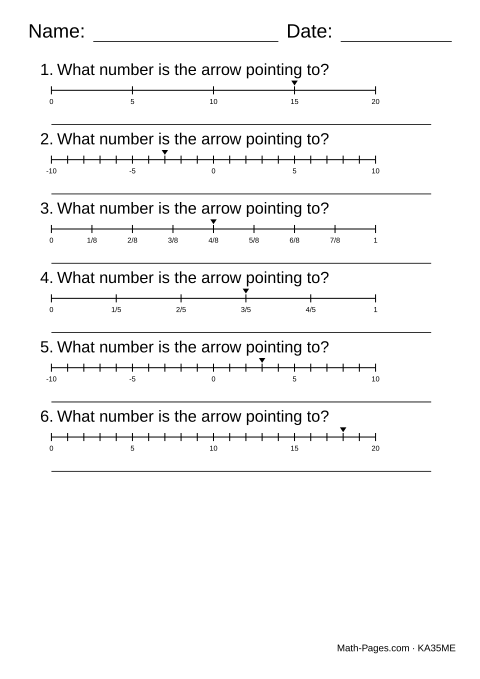
Each problem is a drawn number line with an arrow over one tick, and the question is always the same: what number is the arrow pointing to? The lines mix whole numbers, integers and fractions, so a student has to read the scale before reading the mark.
Not every tick is labelled. On a longer line the labels come every fifth or every second tick, so reaching the arrow means counting on from the nearest one - which is the part of reading a number line that actually takes practice.
What this worksheet covers
- Read the value an arrow points to on a number line
- Work out the scale from the labeled ticks
Common Core standards
- 3.NF.A.2 Understand a fraction as a number on the number line.
- 6.NS.C.6c Find and position integers and other rational numbers on a number line.
Try it on a number line
Move the point along the line, or hop right and left from it, and the line writes the number sentence for each hop.
Frequently asked questions
What is a number line used for?
Seeing where a number sits relative to others. It is how ordering, rounding, negative numbers and fractions are all introduced, because it turns an abstract value into a position.
Why is the arrow always on a tick?
Because a mark between ticks has to be estimated, and two students can read it differently and both be reasonable. Every question here has one right answer.
Do these sheets ask students to draw on the line?
No, and that is deliberate. An answer that is a mark on a line cannot be printed in an answer key - it would have to be a second drawing for a teacher to compare against. These ask students to read a line, not to mark one.
What grade is this for?
Second grade upward for whole numbers, third for fractions on a line, and sixth for integers. Choose the type under Number line to match.