Metric Conversion Worksheets
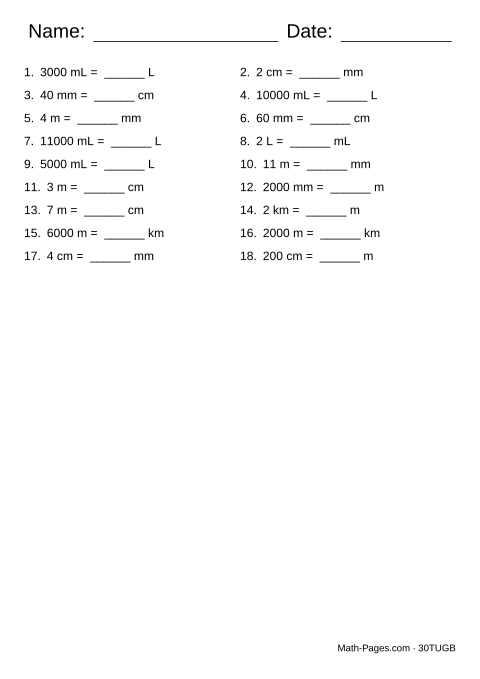
Free printable metric conversion worksheets. mm, cm, m, km, mL, L, g and kg, both directions, with an answer key. Whole-number answers.
Length, volume and mass in metric units: 30 mm = ___ cm, 12,000 mL = ___ L, 7 kg = ___ g. The metric system is built on powers of ten, so every conversion here is multiplying or dividing by 10, 100 or 1,000.
That is the whole reason the metric system is taught this way, and it is also why these sheets pair well with place value work. Moving between mm and m is the same operation as moving a digit three places, and a student who sees that has the system rather than a table to memorise.
What this worksheet covers
- Convert metric units of length, volume and mass
- Multiply or divide by 10, 100 or 1,000
Common Core standards
- 4.MD.A.1 Express a measurement in a larger unit in terms of a smaller unit within one system.
- 5.MD.A.1 Convert between different-sized units within one measurement system.
Frequently asked questions
What are the metric conversions on these sheets?
10 mm in a cm, 100 cm in a m, 1,000 m in a km, 1,000 mm in a m, 1,000 mL in a L, and 1,000 g in a kg.
Is there a trick to metric conversions?
Count the zeros. Every factor here is 10, 100 or 1,000, so converting is moving the decimal point one, two or three places - right when going to a smaller unit, left when going to a larger one.
Why are there no decimal answers?
Because the problems are built from their answers and multiplied up, so nothing divides unevenly. 250 cm = 2.5 m is a genuine conversion and a decimals question; it belongs on a decimals sheet.
What grade is this?
Fourth and fifth grade. It usually arrives once multiplying and dividing by powers of ten is secure, because that is all a metric conversion is.