Unit Conversion Worksheets
Free printable unit conversion worksheets. Metric, customary and time units, both directions, with an answer key. Every answer is a whole number.
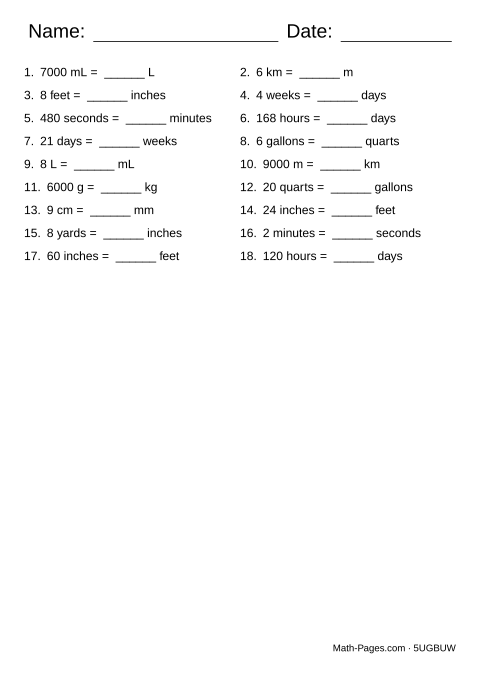
Metric, customary and time units mixed down the page: 30 mm = ___ cm, 8 quarts = ___ cups, 600 seconds = ___ minutes. Each problem states a quantity in one unit and asks for the same quantity in another.
Every answer is a whole number, and that is a deliberate limit rather than an oversight. 250 cm = 2.5 m is a decimals question wearing a conversion's clothes, and a student who cannot yet divide by ten learns nothing from failing it here. Our decimal worksheets are the place for that.
What this worksheet covers
- Convert between metric, customary and time units
- Decide whether to multiply or divide when changing units
Common Core standards
- 4.MD.A.1 Express a measurement in a larger unit in terms of a smaller unit within one system.
- 5.MD.A.1 Convert between different-sized units within one measurement system.
Frequently asked questions
What units are covered?
Metric length, volume and mass (mm, cm, m, km, mL, L, g, kg); customary length, weight and volume (inches, feet, yards, ounces, pounds, cups, pints, quarts, gallons); and time from seconds up to weeks.
Do the sheets convert in both directions?
Yes, and that matters. Going down the scale - 7 kg to 7,000 g - is multiplying and is the easy half. Going up - 324 inches to 9 yards - is dividing, and is where the mistakes happen. Roughly half of each sheet is each.
Are the answers ever decimals?
Never. Every problem is built from its answer and multiplied out, so the division always comes out exactly. That is what keeps this a conversion worksheet rather than a decimals one.
What grade is unit conversion?
Fourth and fifth grade for conversions within one system, which is what these sheets do. Converting between metric and customary is a different skill and is not covered here.