Number Patterns Worksheets
Free printable number pattern worksheets. Find the missing term in a sequence, with an answer key. Counting on, counting back and doubling.
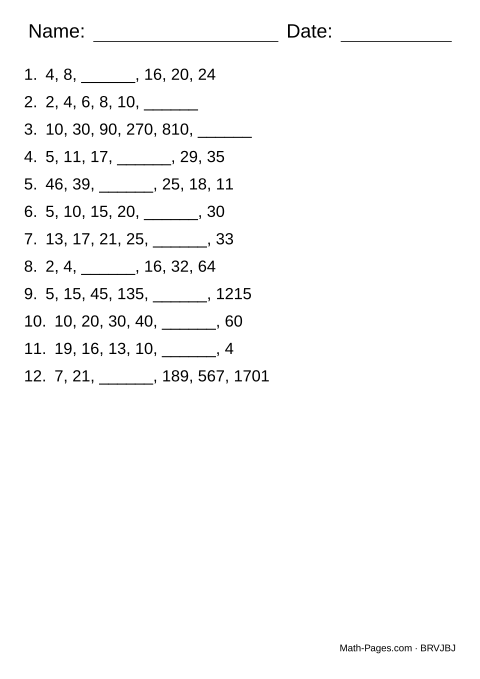
Each problem is a sequence with one term missing: 30, 25, ___, 15, 10, 5. Some count on, some count back, and some double or triple. Finding the gap means working out the rule first.
The blank is rarely at the end, and that is the point. A sequence ending in a blank can be finished by adding to the last number without ever noticing what the pattern is; a gap in the middle cannot. Terms Shown sets how much of the sequence is given - more terms make the rule easier to spot but put the gap further from an edge.
What this worksheet covers
- Find the rule a number sequence follows
- Fill in a missing term by applying the rule
Common Core standards
- 3.OA.D.9 Identify arithmetic patterns, including patterns in the multiplication table.
- 4.OA.C.5 Generate a number pattern that follows a given rule.
Frequently asked questions
What is a number pattern?
A sequence built by the same rule each step: add 5, subtract 5, double. Once you know the rule you can fill any gap in it, forwards or backwards.
How do you find the missing number?
Compare two terms that are next to each other to find the step, then check it holds across the whole sequence before applying it to the gap. Two terms are enough to guess with and three are enough to be sure.
Why is the blank not always at the end?
Because a blank at the end can be filled without understanding the pattern - you add the step to the last number and stop. A gap in the middle has to be reached from both sides.
What grade is this for?
Third and fourth grade for counting on and back, and fourth and fifth for doubling and tripling patterns.