Skip Counting Worksheets
Free printable skip counting worksheets. Count by 2s through 12s with a missing number in the sequence, and an answer key.
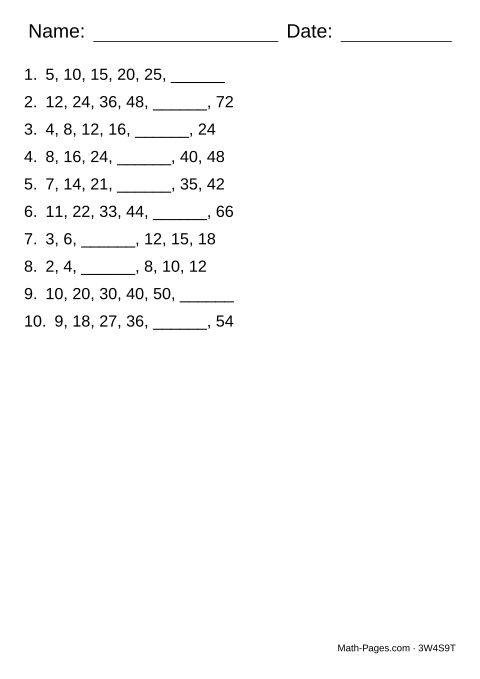
Counting by 2s, 3s, 5s and up to 12s, with one number missing from the sequence: 6, 12, 18, 24, ___, 36. Every sequence starts at the number being counted by, so it is the times table written out in order.
That is exactly what makes skip counting worth practising - it is multiplication before the word arrives. A student who can count by sixes to 72 already knows the six times table; these sheets make the sequence visible so the gap has to be reasoned to rather than recited past.
What this worksheet covers
- Skip count by numbers from 2 to 12
- Fill in a missing number in a counting sequence
Common Core standards
- 2.NBT.A.2 Count within 1,000 and skip-count by 5s, 10s and 100s.
- 3.OA.D.9 Identify arithmetic patterns, including patterns in the multiplication table.
Frequently asked questions
What is skip counting?
Counting in steps larger than one: 3, 6, 9, 12 instead of 1, 2, 3, 4. It is the foundation of multiplication and of reading a clock in fives.
Which numbers can I count by?
These sheets use 2 through 12. Each worksheet mixes several, so a student has to work out the step from the sequence rather than being told it.
Why is the missing number in the middle?
Because a gap at the end can be filled by adding the step to the last number without noticing the pattern. A gap in the middle has to be reached from both sides, which is the skill.
What grade is skip counting?
Second and third grade, usually alongside or just before the times tables.