Converting Fractions, Decimals and Percents
Free printable worksheets converting between percents, decimals and fractions. One direction per question, with an answer key.
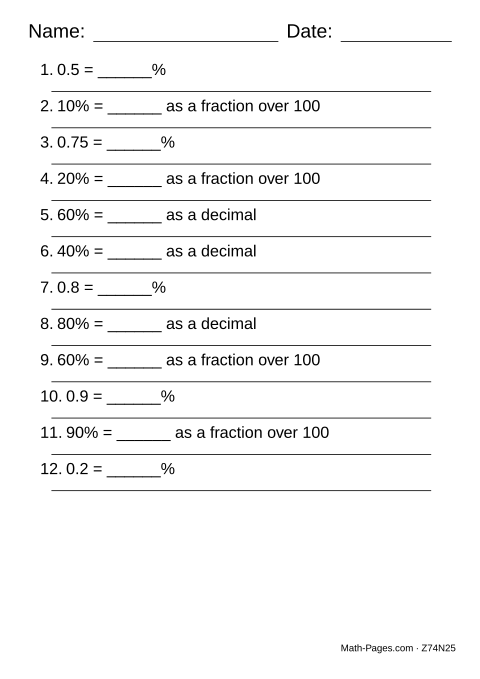
Each question asks for one conversion, in one direction: 20% as a decimal, 75% as a fraction, 0.4 as a percent. One blank per question, so a student is never filling in a row of three and losing track of which is which.
The fractions are written over 100 - 40% is 40/100 - and are not simplified. That is deliberate: simplifying is a separate skill with its own page, and a student who converts correctly and leaves 40/100 has done exactly what was asked.
What this worksheet covers
- Write a percent as a decimal or a fraction
- Write a decimal as a percent
Common Core standards
- 6.RP.A.3c Find a percent of a quantity as a rate per 100.
Frequently asked questions
How do you convert a percent to a decimal?
Divide by 100, which moves the decimal point two places left. 45% becomes 0.45, and 7% becomes 0.07. Going the other way, multiply by 100.
Why are the fractions not simplified?
Because that is a different question. 40% is 40/100, and reducing that to 2/5 is the skill our simplifying fractions worksheets ask for. Testing both at once means marking a correct conversion wrong.
Which percentages appear?
The benchmarks worth knowing by heart: 10, 20, 25, 40, 50, 60, 75, 80 and 90 percent. These are the ones that come up in real arithmetic and the ones whose fraction forms are worth recognising.
What grade is this?
Sixth grade, usually the first thing taught in a percent unit because everything after it depends on seeing that the three forms are one number.