Percent of Change Worksheets
Free printable percent of change worksheets. Apply a rise or a fall of a given percentage and find the new value, with an answer key.
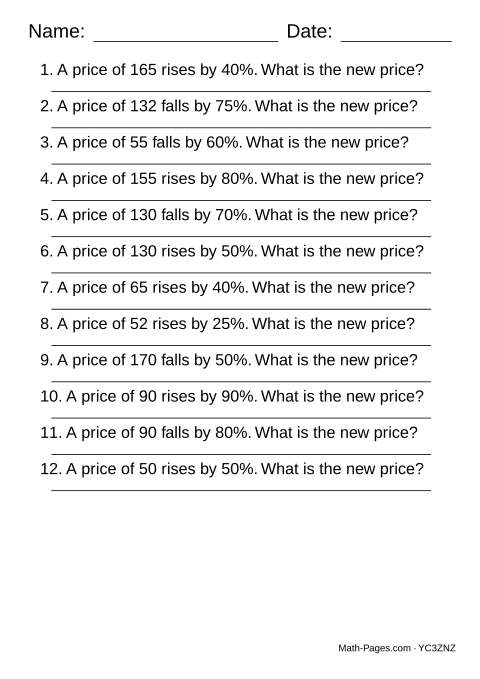
Each question states a starting value and a percentage rise or fall, and asks for the new value: a price of 160 rises by 60%; a price of 180 falls by 75%. Both directions appear on every sheet, roughly half each.
This is percent of a number with one more step, and it is the version adults actually use - a sale price, a tip, a pay rise, an interest charge. The values are written as plain numbers rather than amounts of money, because the arithmetic is the point and a currency symbol would suggest these sheets deal in change.
What this worksheet covers
- Find a new value after a percent increase
- Find a new value after a percent decrease
Common Core standards
- 7.RP.A.3 Use proportional relationships to solve multistep ratio and percent problems, including percent increase and decrease.
Frequently asked questions
How do you work out a percentage increase?
Find the percentage of the starting value, then add it on. For 160 rising by 60%: 60% of 160 is 96, so the new value is 256. For a fall, subtract instead.
Is there a shortcut?
Yes. A 60% rise means the new value is 160% of the old one, so multiply by 1.6 directly. A 25% fall means multiplying by 0.75. It is one step instead of two, once the idea is secure.
Do the sheets ask for the original value back?
No. Working backwards from a changed value - "after a 20% discount it costs 32, what was the original?" - is a harder question and a separate skill. These sheets go forwards only.
What grade is percent of change?
Seventh grade. It follows finding a percentage of a number, which is sixth.