Algebra Worksheets
Free printable beginning algebra worksheets: one- and two-step equations, inequalities and expressions to evaluate, in whole numbers, with an answer key.
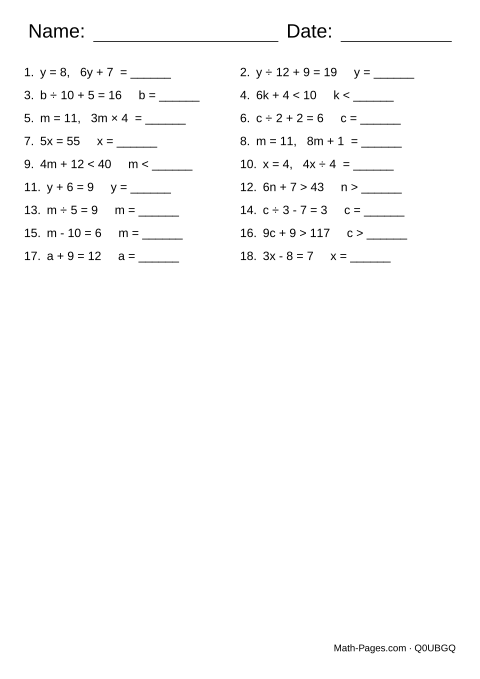
Four kinds of problem, mixed down the page: one-step equations like x + 7 = 12, two-step equations like 3c + 4 = 25, one-variable inequalities like 2x + 3 > 11, and expressions to evaluate - n = 9, then 4n ÷ 4. The first and last are sixth-grade Expressions and Equations work; the two in the middle are seventh grade's, so this sheet reaches a little past the grade the rest of the page is written for.
These are deliberately beginning algebra. Every solution is a whole number, every division comes out even, and nothing goes below zero unless you tick Negative numbers under Advanced options. Largest number sets how big the values get - 10 and 12 are for a first week, 20 and 50 once the arithmetic is not the hard part any more. The operator buttons decide which operations the equations use, so a multiplication-only sheet is all 6a = 42.
What this worksheet covers
- Solve one-step and two-step equations
- Solve a one-variable inequality
- Evaluate an expression when the variable's value is given
Common Core standards
- 6.EE.A.2c Evaluate expressions, including at given values of their variables, using the order of operations.
- 6.EE.B.7 Solve one-step equations of the form x + p = q and px = q.
- 7.EE.B.4a Solve equations of the form px + q = r.
Frequently asked questions
What is on these algebra worksheets?
Four kinds, mixed: one-step equations, two-step equations, inequalities, and expressions to evaluate at a given value. Choose one under Question to get a sheet of only that kind - Solve for the Variable, Two-Step Equations, Inequalities or Evaluate the Expression.
What grade is this for?
Sixth grade for one-step equations and evaluating expressions, seventh for two-step equations and inequalities. It is the first algebra a student meets: a letter standing for one number that can be worked out, rather than an unknown that has to be manipulated.
Are there negative numbers?
Not unless you ask for them. Tick Negative numbers under Advanced options and solutions, and the coefficients in inequalities, can go below zero. Two-step equations and inequalities each have a page of their own for a sheet of only that kind.
How is this different from the missing number worksheets?
34 + ___ = 61 asks a student to complete an arithmetic sentence. 34 + x = 61 asks them to read a letter as a number they do not know yet. The arithmetic is identical and the skill is not, which is why the two are separate pages.
More algebra worksheets
- Two-Step Equations WorksheetsSolve equations that take two steps
- Inequalities WorksheetsSolve two-step inequalities
- Inequalities with Negative NumbersSolve inequalities with negative coefficients
- One-Step Equations WorksheetsSolve equations with one operation on the variable
- Evaluating Expressions WorksheetsSubstitute a value for the variable in an expression