Evaluating Expressions Worksheets
Free printable evaluating expressions worksheets. Substitute a value for the variable and work out the expression - n = 5, then 3n + 2. With answer key.
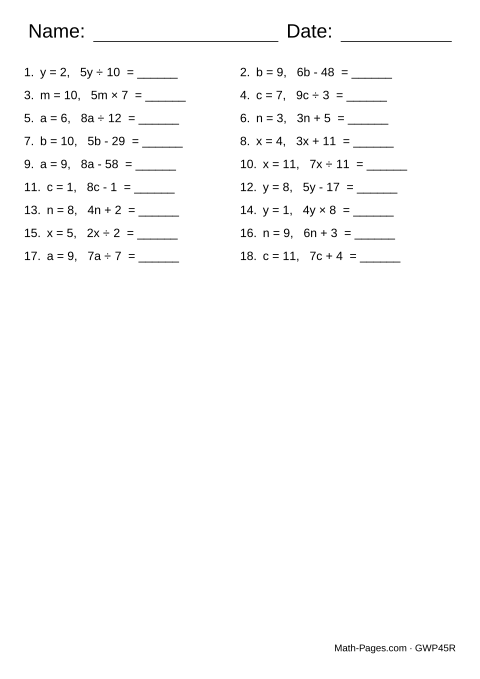
Each problem gives the variable a value and then an expression built on it: n = 9, then 4n ÷ 4. The student substitutes, then works it out. There is nothing to solve for - the letter's value is stated - which makes this the gentler half of beginning algebra and a sensible place to start before one-step equations.
Every expression is two operations at most and every result is a whole number, never negative, with divisions that come out even. The operator buttons choose which operation follows the term, so you can hold a sheet to addition while substitution itself is the new thing.
What this worksheet covers
- Substitute a value for the variable in an expression
- Evaluate the expression using the order of operations
Common Core standards
- 6.EE.A.2c Evaluate expressions, including at given values of their variables, using the order of operations.
Frequently asked questions
What does it mean to evaluate an expression?
Put the given number in place of the letter and work out what the expression comes to. If n = 9, then 4n ÷ 4 is 36 ÷ 4, which is 9.
What does 4n mean?
Four times n. The multiplication sign is left out once a letter is involved. Students who read 4n as a two-digit number rather than a multiplication are making the mistake these sheets are meant to catch early.
Do students need the order of operations for these?
Yes, for the term itself: in 4n - 7 the multiplication happens before the subtraction. The expressions are short enough that this is one decision rather than a chain - our order of operations worksheets are the place for longer ones.
Are the answers ever negative or fractional?
Never. The subtraction is always drawn from inside the term and the divisions always divide exactly, so a student who has not met negative numbers or remainders will not run into either here.