Inequalities Worksheets
Free printable one-variable inequality worksheets. Solve 2x + 3 > 11 and state the answer as x > 4, with an answer key.
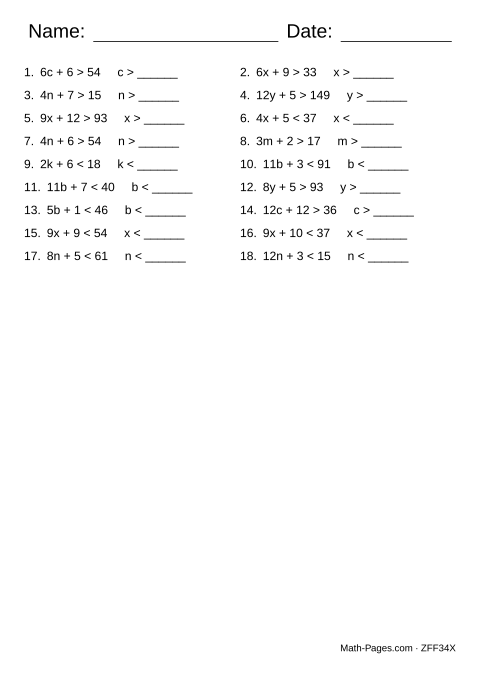
Each problem is a one-variable inequality: 2x + 3 > 11. It is solved exactly like an equation - subtract, then divide - and the answer is written the same way except that the relation stays: x > 4.
That is the point of starting here. An inequality is an equation whose answer is a range rather than a value, and once that is clear the arithmetic holds no surprises. The surprise comes when a negative is involved, which is the next page.
What this worksheet covers
- Solve two-step inequalities
- Write the solution as an inequality in the variable
Common Core standards
- 7.EE.B.4b Solve inequalities of the form px + q > r or px + q < r.
Frequently asked questions
How do you solve an inequality?
The same way as an equation. Subtract, then divide, keeping the relation between the two sides as you go. 2x + 3 > 11 becomes 2x > 8, then x > 4.
What does x > 4 mean?
Every number bigger than 4 makes the original inequality true - 5 does, 4.1 does, 4 itself does not. The answer is a range, not a single value.
Do these ever flip the sign?
Not on this page - every coefficient here is positive. Our inequalities with negatives worksheets cover the case where the relation reverses.
What grade are inequalities?
Sixth and seventh grade. Writing and reading them comes first; solving them follows one-step and two-step equations.