Multiplication and Division Word Problems
Free printable multiplication and division word problems mixed on one page, with division stories that ask how many groups or how many in a row. With an answer key.
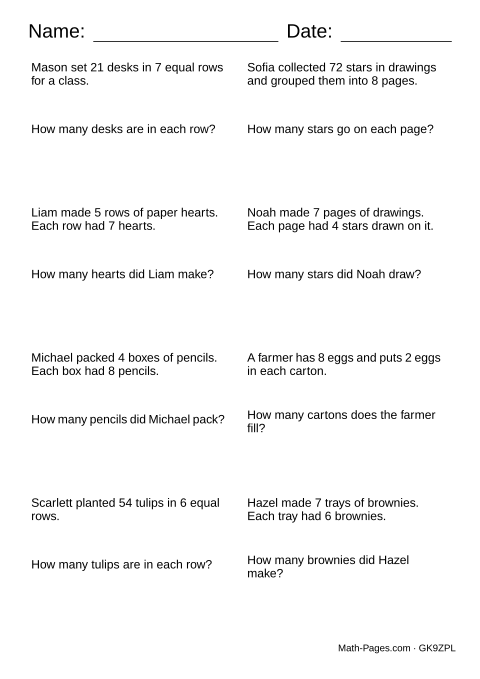
Multiplication and division stories, four of each on a page, drawn from the tables 2 to 9. The word "each" shows up in all of them: "Each box had 9 toys" is a multiplication, "puts 8 eggs in each carton" is a division, and so is "how many go on each shelf?". So "each" stops being a signal, and the student has to decide whether the story gives the groups and asks for the total, or gives the total and asks about the groups.
Two kinds of division are here that the single-operation page leaves out. One asks how many groups: 48 eggs, 8 to a carton, how many cartons? The other puts a total in equal rows and asks how many are in each row. Their answer lines show the multiplication behind the division, ? x 8 = 48, so 48 ÷ 8 = 6, which is how third grade defines it. Set Story types to Simple under Advanced options for the ordinary stories only.
What this worksheet covers
- Decide whether a story needs multiplication or division
- Find the number of groups, or the number in each group
- Write the multiplication fact behind a division story
Common Core standards
- 3.OA.A.3 Use multiplication and division within 100 to solve word problems.
- 3.OA.B.6 Understand division as an unknown-factor problem.
Frequently asked questions
What is the difference between the division stories on this page?
Some share a total out and ask how many each gets: 12 books on 3 shelves is 12 ÷ 3 = 4 on each. Some put a fixed number in each group and ask how many groups: 48 eggs at 8 to a carton is 48 ÷ 8 = 6 cartons. Some arrange a total in equal rows and ask how many are in a row: 63 chairs in 9 rows is 63 ÷ 9 = 7. It is the same operation each time, which is the point of putting them side by side.
How are the answers written?
A multiplication story prints one line, such as 9 x 8 = 72. A division story that asks for the number of groups, or the number in a row, prints the multiplication it comes from and then the division: ? x 8 = 48, so 48 ÷ 8 = 6. Division by sharing, which asks how many each gets, prints just the division.
Which tables does this page use?
The tables from 2 to 9, the same as the multiplication and division word problem pages, with products up to 81. Use First number and Second number to change them. Zero is left out of every word problem sheet, and 1 is left out of this one because a story about 1 group of something makes a poor problem.
Do the stories ever need two steps?
No. Each story takes one multiplication or one division. Mixing the two is what makes the student choose, and a two-step problem asks for something different: planning a path through the numbers rather than choosing an operation.