Addition and Subtraction Word Problems
Free printable addition and subtraction word problems mixed on one page, including stories where the obvious operation is the wrong one. With an answer key.
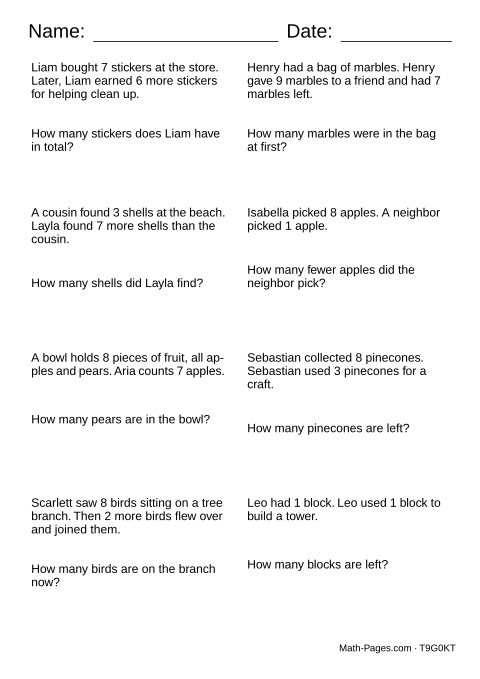
These pages mix addition and subtraction stories, four of each on a page, so a student has to read the story to decide which to use. Many are built so the usual cue points the wrong way. One says "left" and is solved by adding: 2 children went home, which left 6 in the park, so how many were there at first? Another says "some more" and is solved by subtracting: Luca had 2 stickers, a friend gave Luca some more, and now Luca has 9. How many did the friend give?
Comparison stories are here too ("how many more books did Mila read?"), and so are stories that give a whole and one part and ask for the other. The answer key prints the sentence the story describes, then the sum that solves it, so a student who chose the wrong operation can see where the story went the other way. If your class needs the plain take-away and join stories first, open Advanced options and set Story types to Simple.
What this worksheet covers
- Decide whether a story needs addition or subtraction
- Solve stories where the start, the change or a part is the unknown
- Compare two amounts to find how many more
Common Core standards
- 1.OA.A.1 Use addition and subtraction within 20 to solve word problems.
- 2.OA.A.1 Use addition and subtraction within 100 to solve one- and two-step word problems.
Frequently asked questions
Why do some stories say "left" but need addition?
Because the amount left is given and the question asks what there was before. If 2 children went home and 6 were left in the park, the park started with 6 + 2 = 8. A student who sees "left" and subtracts gets 4, which is a number that fits the story but is not the answer. Stories like this are why the page mixes both operations: they show whether a student read the story or matched a word.
How are the answers written?
Where the story asks for a result, the key prints one line, such as 8 - 6 = 2. Where the unknown is a start, a change or a part, it prints the sentence the story describes with a question mark for the unknown, then the sum that finds it: 2 + ? = 9, so 9 - 2 = 7.
Can I make the stories simpler?
Yes. Open Advanced options and set Story types to Simple. The page then draws only the ordinary stories, where someone has some and gets more or loses a few and the question asks how many now.
What grade is this page for?
First and second grade with single digits, where the sums stay within 20. Set Digits to 2 for second grade, where the numbers need regrouping. A third-grade class that also needs multiplication and division will want Mixed Operation Word Problems.