Adding Decimals
Free printable adding decimals worksheets: tenths and hundredths up to 20, with short numbers padded by a zero so the points align. Answer key.
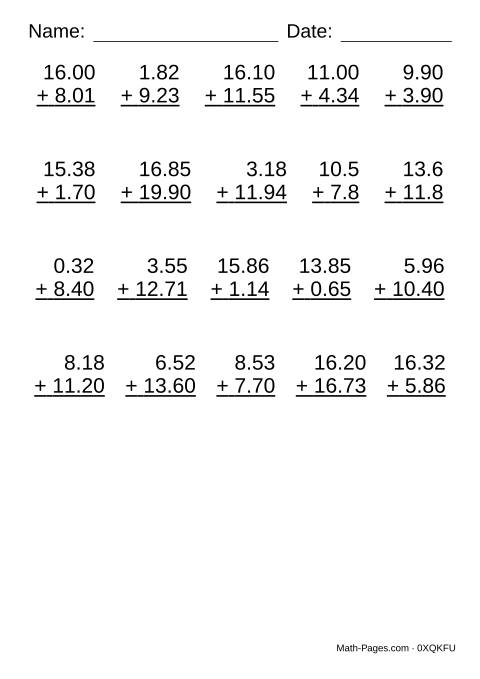
Twenty addition problems a sheet, with numbers up to 20 written to one or two decimal places. The places are chosen separately for each number, so one problem is 1.4 + 1.4 and the next is 6.95 + 4.1, and a shorter number is printed padded with a zero, 4.10, so the two points line up.
That padding is the lesson. About six problems in ten show a zero that only holds a place, and a student who sees why 4.1 and 4.10 are the same number has understood decimal place value rather than just learned to line things up. Most sums pass 10, so the whole-number part carries too.
What this worksheet covers
- Add decimals to hundredths in columns
- Write in zeros so both numbers have the same number of decimal places
Common Core standards
- 5.NBT.B.7 Add, subtract, multiply and divide decimals to hundredths.
Frequently asked questions
How do you add decimals?
Line up the decimal points, fill the short number's missing places with zeros, then add column by column and carry as usual. Bring the point straight down into the answer.
What if one number has more decimal places than the other?
Pad the shorter one with zeros on the right so both have the same number of places - 4.6 becomes 4.60 next to 12.35. These sheets print that padding for you, so the columns you add are the columns you see.
Is 4.1 the same as 4.10?
Yes. The zero adds no hundredths, so 4.1 and 4.10 name the same amount: four and one tenth, or four and ten hundredths. Writing the zero in lets a student add hundredths to hundredths.
Can I keep every number to one decimal place?
Yes. Set Decimal places to 1 and every number is written to tenths, which suits a student meeting decimal addition for the first time. Tenths never need padding, so the sheet is about carrying alone.
What grade is adding decimals?
Fifth grade, where adding and subtracting decimals to hundredths is a standard. Fourth grade writes tenths and hundredths as decimals but does not usually add them in columns yet.