Subtracting Decimals
Free printable subtracting decimals worksheets: tenths and hundredths up to 20, larger number on top, short numbers padded with a zero. Answer key.
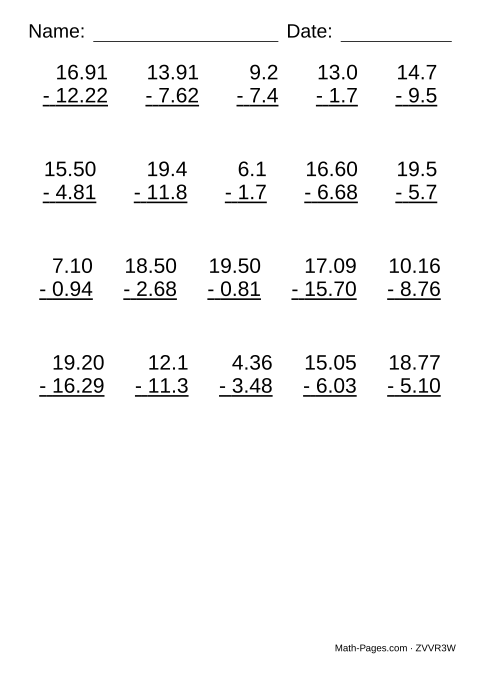
Twenty subtraction problems a sheet, with numbers up to 20 and the larger one always on top. Each number gets one or two decimal places, drawn separately, and the shorter one is padded with a zero, so 14.3 - 2.17 prints as 14.30 - 2.17 and the hundredths column has something to take from.
About one problem in sixteen has a whole number on top, printed as 8.00 or 12.0, which means borrowing through every decimal column at once. Set Decimal places to 1 to keep every number to tenths while borrowing across the point is still new.
What this worksheet covers
- Subtract decimals to hundredths in columns
- Borrow across the decimal point
Common Core standards
- 5.NBT.B.7 Add, subtract, multiply and divide decimals to hundredths.
Frequently asked questions
How do you subtract decimals?
Line up the decimal points, pad the shorter number with zeros so both have the same number of places, then subtract column by column, borrowing as usual.
What makes 4.00 - 1.35 harder?
There is nothing in the top number's decimal places to subtract from, so you borrow through two columns at once. It is the decimal version of 400 - 135.
Do I need to write the extra zeros?
Yes, when the top number is shorter. In 5.2 - 1.47, write 5.20 so there is a hundredths digit to subtract from. Without it, students often copy the 7 straight down and get 3.87 instead of 3.73.
What grade is subtracting decimals?
Fifth grade, alongside adding decimals to hundredths. The numbers here stop at 20, which keeps the attention on the decimal columns rather than on long whole-number subtraction.