Multiplying Decimals
Free printable multiplying decimals worksheets. Multiply a decimal by a whole number or by another decimal, with an answer key.
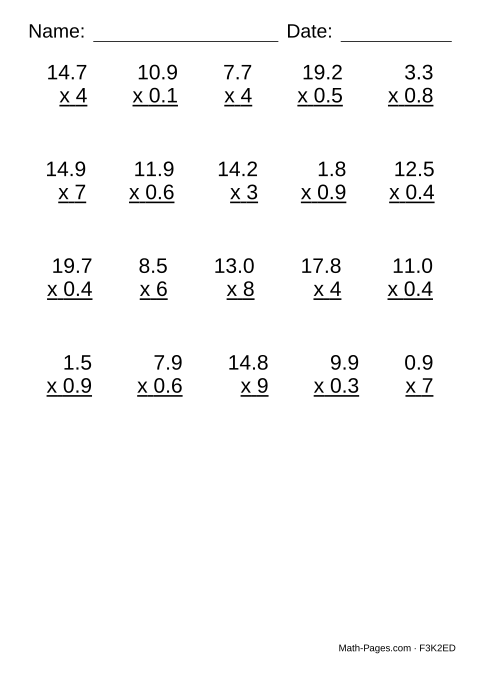
Multiplying decimals, set to one decimal place so the answers stay short. About half the problems are a decimal times a whole number - six lengths of 1.4 metres - and about half are a decimal times a tenth, like 3.6 x 0.4, where the answer has two places. Multiplying two two-place decimals gives a four-place answer, which no elementary curriculum asks for, so the sheets do not do it.
The rule to practise: multiply as if there were no points, then count the decimal places in the two numbers and put that many in the answer. 3.6 x 0.4 has two places between them, so 144 becomes 1.44.
What this worksheet covers
- Multiply a decimal by a whole number or by another decimal
- Place the decimal point in the product by counting decimal places
Common Core standards
- 5.NBT.B.7 Add, subtract, multiply and divide decimals to hundredths.
Frequently asked questions
How do you multiply decimals?
Ignore the points and multiply the numbers whole. Then count the total decimal places in the two factors and place the point that many digits from the right of the answer.
Why does multiplying sometimes make the number smaller?
Because multiplying by a number less than one shrinks it. 3.6 x 0.4 is four tenths of 3.6, so 1.44 is right even though it looks wrong. Roughly half the problems on a sheet are of this kind.
Do you line the points up like with adding?
No. Alignment matters for adding and subtracting decimals, not for multiplying. Multiply as whole numbers and place the point at the end by counting.
How can I check the decimal point is in the right place?
Estimate first. 3.6 x 0.4 is a little less than half of 3.6, so the answer should be near 1.5. That rules out 14.4 and 0.144 and leaves 1.44.