Decimal Worksheets
Free printable decimal worksheets. Add, subtract and multiply decimals in column format, with operands of different lengths and an answer key.
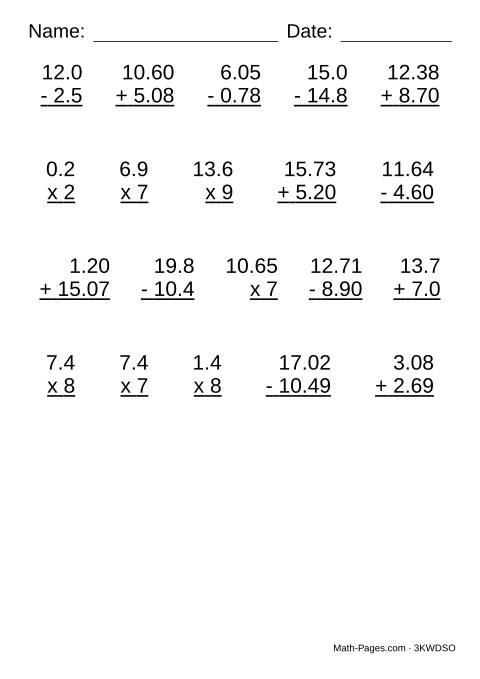
Adding, subtracting and multiplying decimals, laid out in columns with the decimal points aligned. Where one number is drawn shorter than the other it is written out to the same width - 4.6 next to 12.35 prints as 4.60 - so the columns line up and the padding is visible rather than assumed. Seeing 4.60 written down is how the idea that 4.6 and 4.60 are the same number stops being something a student has to take on trust.
Numbers run to two decimal places and twenty by default, and the sheet mixes one- and two-place problems as it goes; set Decimal places to 3 for thousandths. Set Decimal places to 1 for a first pass, or untick operations above to spend a page on just one.
What this worksheet covers
- Add, subtract and multiply decimals to hundredths
- Line up decimal points and fill in zeros so the columns match
Common Core standards
- 5.NBT.B.7 Add, subtract, multiply and divide decimals to hundredths.
Frequently asked questions
What grade are decimals taught in?
Decimal notation starts in fourth grade; adding and subtracting decimals is fourth and fifth, multiplying and dividing them fifth and sixth.
Why is a number like 4.6 written as 4.60?
So both numbers in a problem have the same number of decimal places and the columns line up. 4.60 and 4.6 are the same value - the zero holds an empty hundredths column rather than adding anything.
Are the answers exact?
Yes. Every value is held as a whole number of thousandths and the arithmetic is done on integers, so no answer key ever shows 0.30000000000000004.
What is the most common mistake with decimals?
Lining up the last digits instead of the decimal points. Written that way, 4.6 + 12.35 comes out as 12.81 instead of 16.95. Writing 4.6 as 4.60 first makes the columns match.