Adding Money
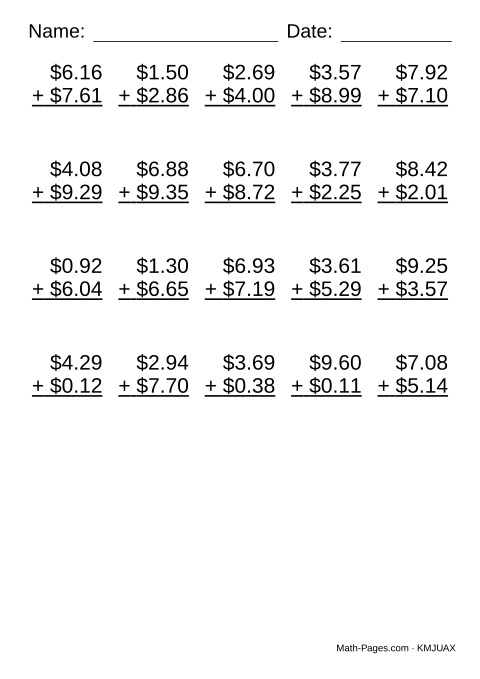
Free printable adding money worksheets: dollar-and-cent amounts under $10 in columns, where about half the problems carry cents into dollars.
Twenty addition problems a sheet, each a pair of dollar-and-cent amounts under $10, such as $3.61 + $0.69. Every amount has exactly two places after the point, because that is how money is written, so the columns always line up and the one new idea is the step money adds: 100 cents make a dollar.
About half the problems carry out of the cents and into the dollars, and about half the totals pass $10, so the dollars column grows a second digit. Choose Under $1 under Amounts while that carry is new, or Under $100 for bigger totals.
What this worksheet covers
- Add dollar-and-cent amounts with the decimal points aligned
- Carry from the cents into the dollars
Common Core standards
- 4.MD.A.2 Solve word problems about distance, time, volume, mass and money, including decimals.
- 5.NBT.B.7 Add, subtract, multiply and divide decimals to hundredths.
Frequently asked questions
How do you add money amounts?
Write the amounts so the dollar signs and decimal points line up, add the cents, and carry a dollar if they reach 100 or more. Then add the dollars, carried dollar included, and put the point and the dollar sign in the answer.
What happens when the cents add up to more than a dollar?
The extra dollar carries into the dollars column, exactly like carrying a ten. In $2.85 + $1.40 the cents make 125, so write 25 cents and carry 1 dollar. The answer is $4.25.
Why is every amount written with two decimal places?
Because money is counted in whole cents. $3.60 is three dollars and sixty cents; $3.6 means the same in arithmetic but never appears on a price tag, and a student who reads it as three dollars and six cents has shown why.
How can a student check a total?
Round each amount to the nearest dollar first. $3.61 + $0.69 is about $4 + $1, so an answer near $5 is right and $10.30 means a misplaced point. The exact answer is $4.30.
Can I make the amounts larger or smaller?
Yes. Under Amounts, choose Under $1 to keep every problem in cents, or Under $100 for totals that carry across three columns.
What grade is adding money?
Adding dollars and cents comes up in fourth grade, inside measurement word problems, and adding them in columns is fifth-grade decimal work. Younger students count coins first, which is what the Counting Money page is for.