Making Change Worksheets
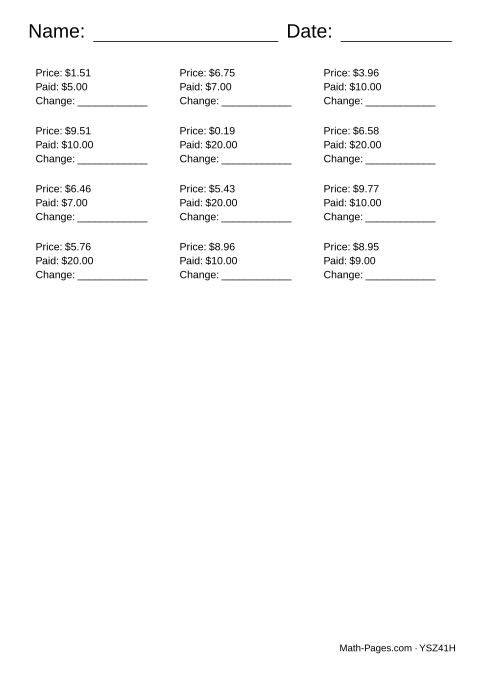
Free printable making change worksheets. A price, the amount paid, and work out the change - amounts a person would really hand over - with an answer key.
Each problem gives a price and the amount handed over, and the student works out the change. The amount paid is always something a person would actually use - the next dollar up, or a round five or ten - so the problems read like real purchases.
The answer key gives the change as an amount. Counting up from the price is the method most people use, and a student can do it here even though the worksheet does not walk through the steps.
What this worksheet covers
- Work out the change from a price and the amount paid
- Count up from the price to the amount handed over
Common Core standards
- 4.MD.A.2 Solve word problems about distance, time, volume, mass and money, including decimals.
Frequently asked questions
How do you make change?
Start at the price and count up to the amount paid: coins to the next ten cents, then to the next dollar, then dollars. The total you counted is the change.
Why is the amount paid always a round number?
Because that is what happens at a till. You do not pay $7.43 for a $6.18 item - you hand over a ten, or seven ones, or a five and three ones.
Is making change just subtraction?
The answer is the same as a subtraction, but counting up is easier to do in your head and is how it is actually done. The subtracting money page is the column-arithmetic version.
What amounts are used?
Prices under $10 by default. Set Amounts to Under $100 for larger purchases and larger notes.