Counting Money Worksheets
Free printable counting money worksheets. Count drawn pennies, nickels, dimes and quarters, or leave out the quarter for first coin practice. Answer key.
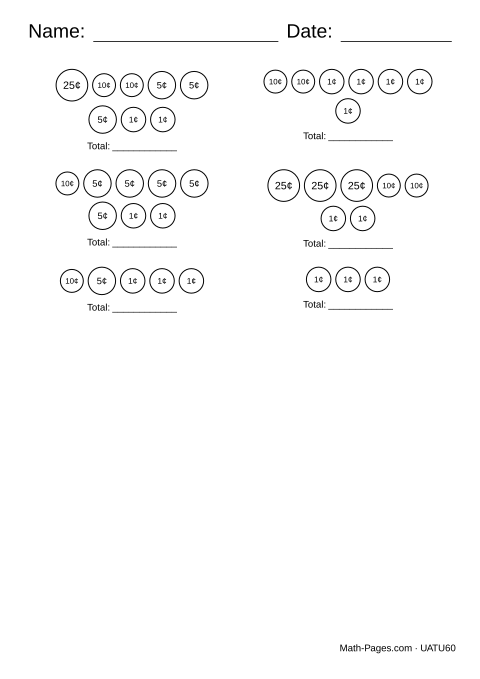
Each problem shows a set of coins, drawn at their real relative sizes, and the student adds up the total. The coins are a genuine mix, not the smallest number of coins that makes the amount, so a student has to look at each one rather than assume the biggest coins first.
For a first counting coins sheet, untick the quarter under Coins. Pennies, nickels and dimes are counted by ones, fives and tens, the skip counting a young student already knows, and the quarter can come back once those three are solid. The dime is drawn smaller than the nickel and the penny, because it is, and noticing that is part of the exercise.
What this worksheet covers
- Name the value of pennies, nickels, dimes and quarters
- Count a mixed set of coins to find the total
Common Core standards
- 2.MD.C.8 Solve word problems involving dollar bills, quarters, dimes, nickels and pennies.
Frequently asked questions
Which coins are included?
Pennies, nickels, dimes and quarters by default. Untick the quarter for beginners, or add the half dollar and the dollar coin under Coins if your students have seen them.
Why start without quarters?
Pennies, nickels and dimes are counted by ones, fives and tens, which a student already knows how to do. A quarter needs counting on by 25s, which is a separate step worth taking on its own.
What grade is counting money for?
Pennies, nickels and dimes usually come in kindergarten and first grade, and quarters in first or second grade. Second grade is where the standards expect a student to count a mix of all four.
Why are the coins not the fewest that make the amount?
Because a real handful of change is not. A page of "three quarters" teaches a student to grab the big coins and guess; a real mix makes them count.
How many coins are in each problem?
Between three and eight. More than that is adding practice rather than coin practice, and it does not fit the row.
Does it print well in black and white?
Yes. The coins are line drawings labelled with their value, sized so a dime and a quarter are clearly different even with no colour.