Money Word Problems
Free printable money word problems. Short stories about spending, saving and earning, adding and subtracting dollar-and-cent amounts, with an answer key.
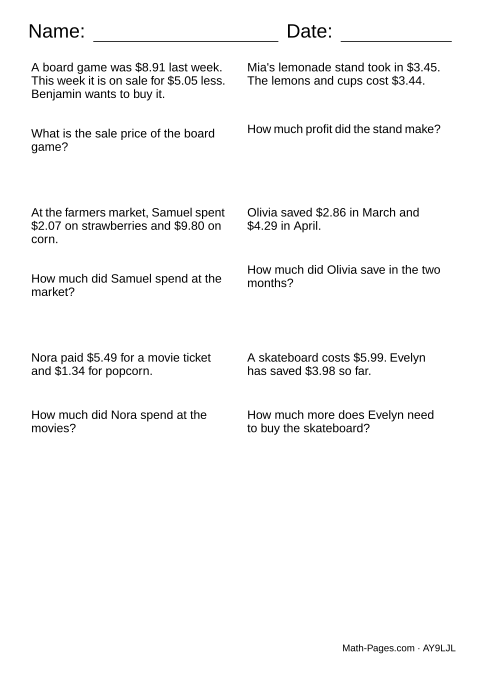
Short story problems about money: buying lunch, saving up for a skateboard, using a coupon, running a lemonade stand. Every amount is written in dollars and cents, like $4.35, so a student has to line up the decimal point and regroup across it to find the answer, the same as they would at a real checkout.
The stories ask the questions money actually raises. How much altogether? How much is left? How much more is needed? How much cheaper is it? Reading which one is being asked is half the work, which is why a page mixes addition and subtraction by default. Tick Multiplication to add stories like four tickets at $3.25 each.
What this worksheet covers
- Solve story problems about spending and saving money
- Decide whether a story needs addition or subtraction
Common Core standards
- 4.MD.A.2 Solve word problems about distance, time, volume, mass and money, including decimals.
Frequently asked questions
What operations do these use?
Addition and subtraction by default. Tick Multiplication for stories that multiply a price by a whole number, such as six notebooks at $1.29 each, or untick Subtraction for addition-only stories.
How big are the amounts?
Under $10 by default, always with cents. Choose Under $1 under Amounts to keep a student in the cents column, or Under $100 for larger totals and more regrouping.
How does a student know whether to add or subtract?
By what the story asks. "How much altogether" and "how much did they spend" are addition. "How much is left", "how much change" and "how much more is needed" are subtraction. Underlining the question before doing any arithmetic helps.
How is this different from the making change page?
Making change is one specific question - price, amount paid, change. These are general money stories: how much altogether, how much is left, how much more is needed.