Comparing Decimals Worksheets
Free printable comparing decimals worksheets. Write <, > or = between two decimals of different lengths, like 0.7 and 0.68.
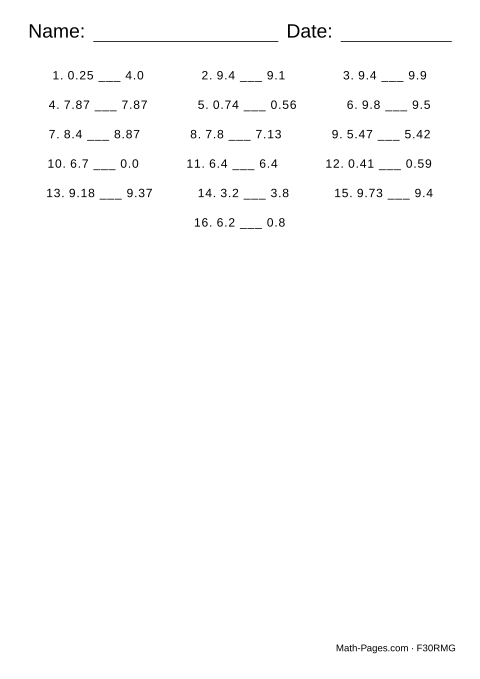
Sixteen pairs a sheet: write <, > or = between two decimals. The two are often written to different lengths on purpose - 0.7 next to 0.68 - because that is the comparison students get wrong. 0.7 is the larger number, even though 68 looks bigger than 7 and "0.68" is the longer string.
The fix is to line the numbers up by their decimal points, not their last digit, and fill any short one with zeros: 0.70 against 0.68. Then it compares the same way whole numbers do.
What this worksheet covers
- Compare two decimals to hundredths with <, > or =
- Compare decimals of different lengths by place value, not by how many digits they have
Common Core standards
- 4.NF.C.7 Compare two decimals to hundredths.
Frequently asked questions
How do you compare two decimals?
Line up the decimal points and compare place by place from the left - tenths first, then hundredths. Pad the shorter number with zeros so both have the same number of places.
Is 0.7 bigger or smaller than 0.68?
Bigger. 0.7 is 0.70, which is seven tenths; 0.68 is six tenths and eight hundredths. Seven tenths beats six, so 0.7 > 0.68. The extra digit in 0.68 does not make it larger.
Why do the two numbers have different numbers of decimal places?
Because that is the case worth practising. When both numbers are the same length the comparison is just like whole numbers; the difficulty is entirely in the unequal lengths.
Does adding a zero change a decimal?
Not at the end. 0.7, 0.70 and 0.700 are the same number. A zero after the point and before the digits does change it: 0.07 is a tenth of 0.7.