Rounding on a Number Line
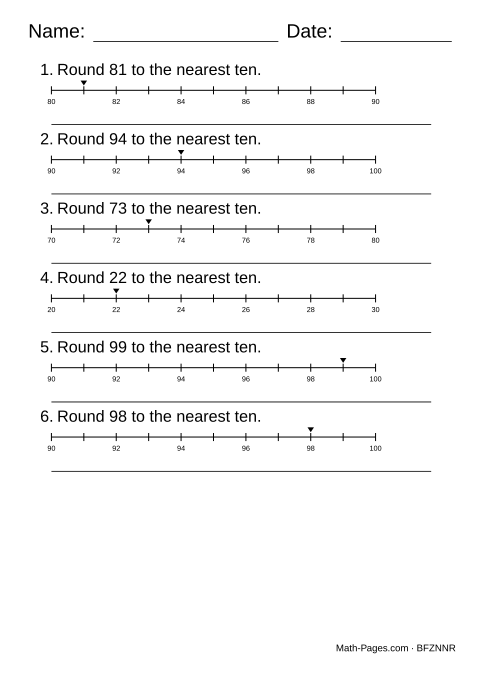
Free printable rounding-on-a-number-line worksheets. Both tens are marked on the line and an arrow points to the number to round: which one is it closer to?
Every problem draws a number line from one ten to the next with an arrow marking the number in between, and the student decides which end it is closer to. This is the representation the standard itself uses to introduce rounding - is 47 nearer 40 or 50? - rather than a column-based rule applied to a number sitting on the page by itself.
The line always shows both tens, never which one is correct: deciding that is the entire question. Only the pairing changes from problem to problem. No number sits exactly on a ten, because an arrow on the tick would give the answer away.
The answer key redraws the same line with the correct ten marked as well, alongside the number - never on the worksheet page itself, where marking it would print the answer.
What this worksheet covers
- Decide which ten a number is closer to on a number line
- Round two-digit numbers to the nearest ten
Common Core standards
- 3.NBT.A.1 Round whole numbers to the nearest 10 or 100.
Try it on a number line
Move the point along the line, or hop right and left from it, and the line writes the number sentence for each hop.
Frequently asked questions
Why does the line only go from one ten to the next?
The marker has to land on a labelled tick to mean anything, and a whole number is only ever exactly at the ones place - so the finest line that still shows real ticks runs between the two nearest tens. A line wide enough for the nearest hundred would need ticks a hundred to a page, which is unreadable.
Why isn't there a nearest-100 or nearest-1,000 version of this page?
Those need a number precise to the tens or hundreds place to land on a tick, and a whole number never is - the line would either be unreadable or use a number that had been stripped of the digit the question is about. The nearest 100 and nearest 1,000 pages use the plain, column-based presentation instead.
Is there an answer key?
Tick Answer key and a matching key prints behind each worksheet page, redrawing the same line with the correct ten marked.