Comparing Numbers Worksheets
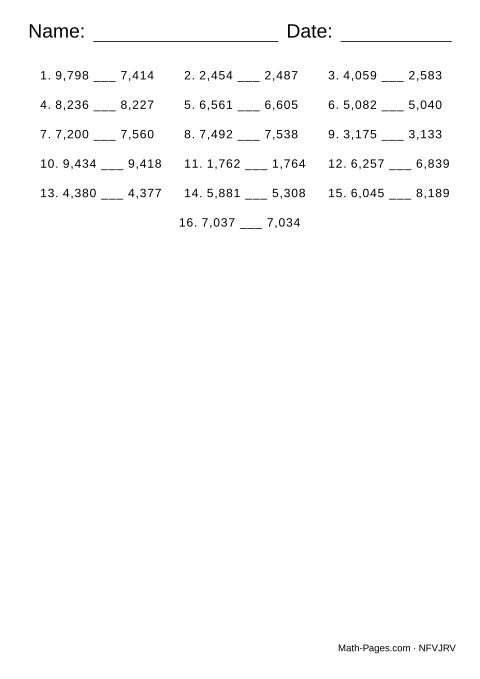
Free printable comparing numbers worksheets. Write the greater than, less than or equal sign between two four-digit numbers.
Sixteen pairs a sheet: write <, > or = in the gap between two four-digit numbers. The two numbers in a pair are built to share leading digits, so 4,382 and 4,328 rather than 4,382 and 1,905 - the answer is found by reading down the number until the digits differ, not by glancing at the first one.
About one pair in ten is equal, so = is a real option rather than a symbol the student can rule out. A page where the answer is always < or > teaches the wrong lesson.
What this worksheet covers
- Compare two four-digit numbers with <, > or =
- Compare place by place, starting from the left
Common Core standards
- 4.NBT.A.2 Read, write and compare multi-digit whole numbers, including in expanded form.
Frequently asked questions
How do you compare two numbers?
If they have the same number of digits, read from the left and compare each place in turn. The first place where the digits differ decides it. If one number has more digits, it is the larger one.
Which way do the < and > signs point?
The open side faces the larger number and the point faces the smaller one: 4,382 > 4,328. Some children learn it as the mouth eating the bigger number.
Why do the pairs look so similar?
On purpose. Two numbers picked at random usually differ in the first digit, and a page of those is answered without reading past it. Sharing the leading digits puts the work where it belongs.
How do you read 4,382 > 4,328 aloud?
"4,382 is greater than 4,328." Read from left to right, < is "is less than" and > is "is greater than". Saying the sentence aloud is a good check that the sign faces the right way.