Rounding Decimals
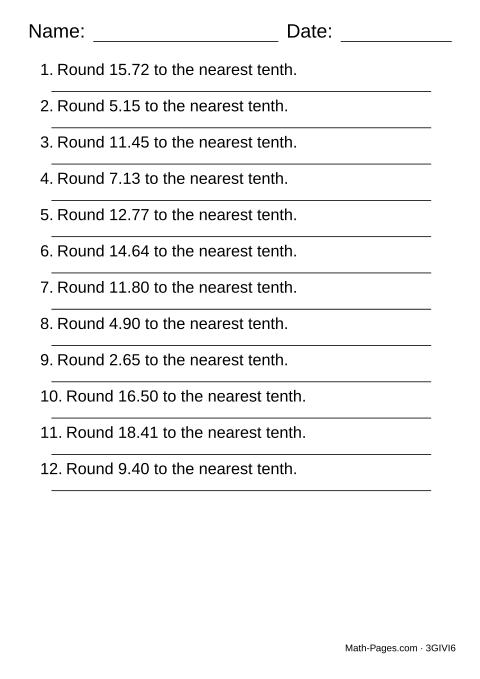
Free printable rounding decimals worksheets. Round a two-place decimal to the nearest tenth, with the hundredths digit deciding.
Rounding a two-place decimal to the nearest tenth: the hundredths digit decides, and the answer keeps one decimal place. 3.28 rounds to 3.3, and 3.25 rounds to 3.3 as well - half rounds up here exactly as it does with whole numbers.
The answer is written to the place it was rounded to, so 3.28 rounds to 3.3, not 3.30. A trailing zero would claim a precision the rounding threw away.
What this worksheet covers
- Round decimals to the nearest tenth
- Use the hundredths digit to decide whether to round up or down
Common Core standards
- 5.NBT.A.4 Round decimals to any place.
Frequently asked questions
How do you round a decimal to the nearest tenth?
Look at the hundredths digit. 5 or more rounds the tenths digit up; 4 or less leaves it. Then drop everything after the tenths place.
Does 3.25 round to 3.2 or 3.3?
3.3. The deciding digit is 5, and half rounds up - the same rule as whole numbers. These half-way cases are put on nearly every sheet deliberately.
Why is the answer 3.3 and not 3.30?
Because it was rounded to the nearest tenth, so the tenths place is as far as the answer goes. Writing 3.30 would suggest the hundredths digit is known to be zero, and rounding just discarded it.
How do you round to the nearest whole number?
Look at the tenths digit instead. 5 or more rounds the ones digit up, so 3.28 rounds to 3 and 3.71 rounds to 4. Set the rounding place to Nearest whole to practice it.