Rounding to the Nearest 10
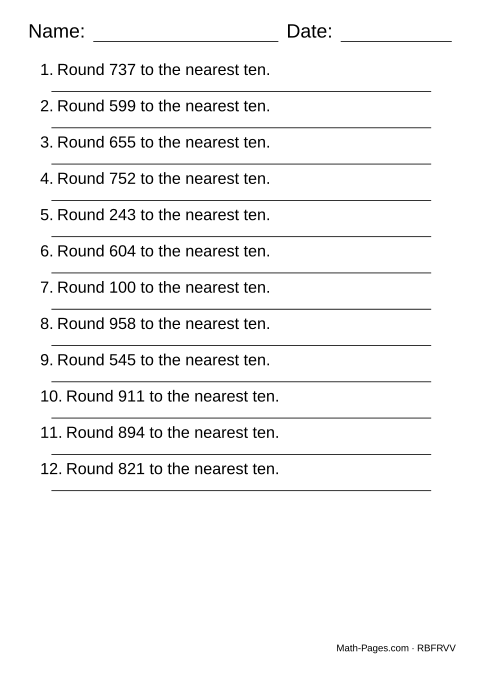
Free printable rounding to the nearest ten worksheets. Round two- and three-digit numbers, with the deciding digit always the ones digit.
Rounding to the nearest ten, and only the nearest ten, so the deciding digit is always the ones digit. Numbers run to three digits, which keeps the rounding place visible without the question becoming about which column to use.
This is where rounding usually starts, in second and third grade. Once the ones digit is a reliable signal - 5 through 9 rounds the tens digit up, 0 through 4 leaves it - the nearest 100 page moves the deciding digit one column left.
What this worksheet covers
- Round numbers up to three digits to the nearest ten
- Use the ones digit to decide whether to round up or down
Common Core standards
- 3.NBT.A.1 Round whole numbers to the nearest 10 or 100.
Frequently asked questions
How do you round to the nearest ten?
Look at the ones digit. If it is 5, 6, 7, 8 or 9, add one to the tens digit and make the ones a zero. If it is 0, 1, 2, 3 or 4, just make the ones a zero.
Does a number ending in 5 round up or down?
Up. 45 rounds to 50, 135 rounds to 140. That is the round-half-up rule, and it appears often enough on each sheet to practise.
What grade is rounding to 10 for?
Second and third grade, usually before rounding to larger places. Whole tens are easy to picture on a number line, which is why it comes first.
Why does 97 round to 100?
The ones digit is 7, so the tens digit rounds up from 9 to 10, and that carries into the hundreds. 97 becomes 100, and 298 becomes 300.