Geometry Worksheets
Free printable geometry worksheets: angle classification, missing angles, complementary and supplementary pairs, triangles and polygons. With an answer key.
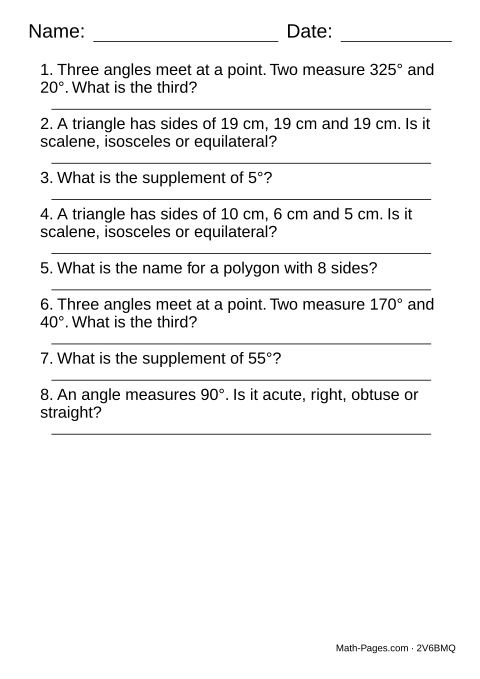
A mixed sheet drawing on all five question types: classifying an angle from its measure, finding a missing angle in a triangle or on a straight line, complementary and supplementary pairs, naming a triangle from its side lengths, and naming a polygon from its side count.
Every figure is described in words rather than drawn — “two angles of a triangle measure 85° and 10°” — so the arithmetic is the whole of the question. That is deliberate: a drawn triangle labelled 85° and 10° adds nothing except a chance for the picture to disagree with its labels, and there is no “measure this with a protractor” question because a printed protractor is only correct if the page prints at exactly 100%.
What this worksheet covers
- Classify angles and triangles
- Find missing angles using angle facts
Common Core standards
- 4.G.A.1 Draw and identify points, lines, rays and angles, including right, acute and obtuse angles.
- 7.G.B.5 Use facts about supplementary, complementary and adjacent angles to find an unknown angle.
Frequently asked questions
What geometry does this cover?
The arithmetic of angles and the naming of shapes: acute, right, obtuse and straight angles; the angle sum of a triangle; angles on a straight line and around a point; complementary and supplementary pairs; classifying triangles by their sides; and polygon names from triangle to decagon.
Why are there no diagrams?
Because these questions do not need one. Every figure is given in words, and the skill being practised is the arithmetic. Questions that genuinely need a picture — vertical angles at crossed lines, for instance — are left out rather than faked with a diagram that might not print to scale.
Can I make the numbers friendlier?
Yes. Under Advanced options, “Angles are multiples of” sets how round every angle is. At 10° you get 180 − 130; at 1° you get 180 − 137. It does not affect the triangle side lengths, which are not angles.
What grade is this?
Fourth grade meets angle types and adding angles (4.MD.C.7), seventh grade does complementary and supplementary pairs (7.G.B.5), and eighth grade uses angle sums (8.G.A.5). Polygon naming and triangle classification start earlier, around third and fourth grade.
More geometry worksheets
- Area and Perimeter WorksheetsFind the perimeter and area of a rectangle
- Area WorksheetsFind the area of a rectangle by multiplying its side lengths
- Perimeter WorksheetsFind the perimeter of a rectangle
- Scale Drawing WorksheetsFind actual lengths from a scale drawing and its scale
- Volume WorksheetsFind the volume of a rectangular prism by multiplying its edge lengths
- Volume with Unit CubesCount the unit cubes that fill a rectangular prism
- Volume of Composite FiguresFind the volume of a solid made of two boxes by adding their volumes
- Surface Area WorksheetsFind the surface area of a rectangular prism from its net
- Circumference of a Circle WorksheetsFind the circumference of a circle from its radius
- Area of a Circle WorksheetsFind the area of a circle from its radius
- Circle WorksheetsFind the circumference of a circle from its radius or diameter
- Pythagorean Theorem WorksheetsFind the hypotenuse of a right triangle from its legs
- Finding the Hypotenuse WorksheetsPick out the hypotenuse as the side opposite the right angle
- Complementary and Supplementary AnglesFind the complement of an angle
- Classifying Triangles by Their SidesClassify a triangle as scalene, isosceles or equilateral
- Types of AnglesClassify an angle as acute, right, obtuse or straight
- Naming PolygonsName polygons from triangle to decagon
- Find the Missing AngleFind a missing angle in a triangle
- Coordinate Plane WorksheetsRead the coordinates of a point in the first quadrant
- Four-Quadrant Coordinate Plane WorksheetsRead and name points with negative coordinates
- Polygons on the Coordinate Plane WorksheetsFind the length of a side from the coordinates of its endpoints
- Area of Triangles WorksheetsFind the area of a triangle as half its base times its height
- Find the Missing Corner of a RectangleFind the missing corner of a rectangle from the coordinates of the other three