Perimeter Worksheets
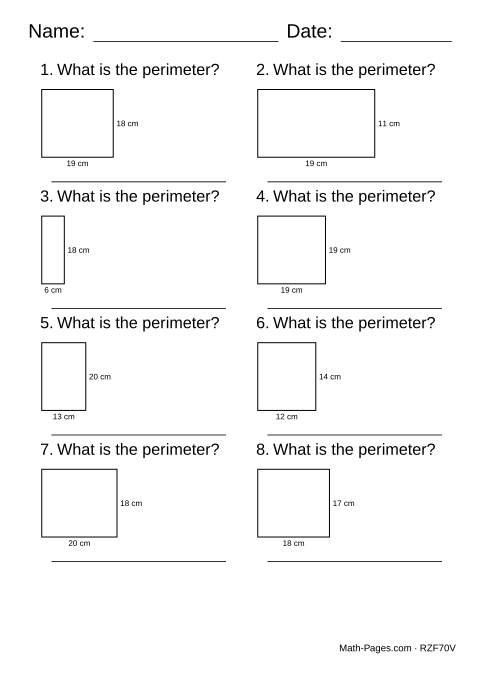
Free printable perimeter worksheets. Add the sides of a labelled rectangle and double. Drawn to scale, with an answer key in cm.
Each problem shows a labelled rectangle and asks for the distance round the outside. Add the two different sides and double, or add all four - both work, and seeing that they agree is worth as much as the answer.
Perimeter is usually taught after area and is the easier of the two, which surprises students who meet them in that order. It is addition, and the only trap is forgetting that a rectangle has four sides rather than two.
What this worksheet covers
- Find the perimeter of a rectangle
- Add all four sides, or double the sum of the length and width
Common Core standards
- 3.MD.D.8 Solve problems involving the perimeters of polygons.
- 4.MD.A.3 Apply the area and perimeter formulas for rectangles.
Frequently asked questions
How do you find the perimeter of a rectangle?
Add all four sides. Since opposite sides are equal, that is the same as adding the two different ones and doubling: a 9 by 3 rectangle has a perimeter of 2 × (9 + 3), which is 24 cm.
Why is the answer in cm and not cm²?
Because a perimeter is a length - the distance you would walk round the edge. Only area is measured in squares.
Can two shapes have the same perimeter and different areas?
Yes, and it is worth noticing. A 1 by 11 rectangle and a 5 by 7 one both have a perimeter of 24 cm, but their areas are 11 cm² and 35 cm².
What grade is perimeter?
Third and fourth grade, usually alongside or just after area.