Volume Worksheets
Free printable volume worksheets: count the cubes in a box, multiply length × width × height, or find a missing edge. Answers in cm³, with a key.
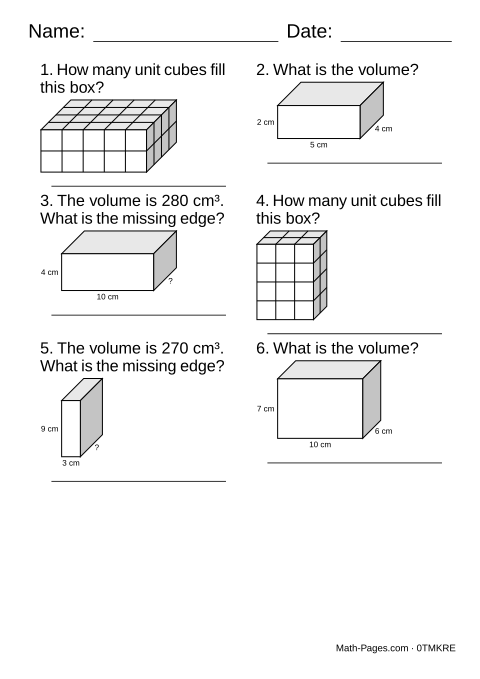
Each problem draws a box, a rectangular prism, and asks about the space inside it. The sheet mixes three questions. Some boxes are drawn in unit cubes for the child to count. Some have their length, width and height labelled, and the child multiplies them for the volume in cubic centimetres. Some give the volume and two of the edges, and the child finds the third.
Putting the counting next to the multiplying is the point of fifth-grade volume. A box 4 cubes long, 3 wide and 5 high has 4 × 3 = 12 cubes in each layer and 5 layers, 60 in all, which is exactly what 4 × 3 × 5 says. Labelled edges are whole centimetres up to 10, and no edge is more than four times another, so every box is drawn at the ratio its labels state.
The settings can set one question for the whole sheet, and move the longest edge down to 5 cm or up to 12 cm. Counted boxes stay between 2 and 5 cubes on a side whatever the setting, so the cubes are large enough to count.
What this worksheet covers
- Find the volume of a rectangular prism by multiplying its edge lengths
- Count the unit cubes that fill a box, layer by layer
- Find a missing edge from the volume and the other two edges
Common Core standards
- 5.MD.C.3 Recognize volume as an attribute of solid figures, measured in unit cubes.
- 5.MD.C.5 Relate volume to multiplication, and find the volume of a right rectangular prism with whole-number edges.
Frequently asked questions
What is volume?
How much space a solid takes up, measured in unit cubes. A box that holds 60 cubes, each 1 cm along every edge, has a volume of 60 cm³.
How do you find the volume of a rectangular prism?
Multiply the length, the width and the height. A box 4 cm by 3 cm by 5 cm has a volume of 4 × 3 × 5 = 60 cm³: 12 cubes in the bottom layer, and 5 layers of them.
How do you find a missing edge?
Multiply the two edges you know, then divide the volume by that. If the volume is 60 cm³ and two edges are 4 cm and 3 cm, the third is 60 ÷ 12 = 5 cm.
Why is the answer in cm³?
Because volume counts cubes. The small 3 says three lengths were multiplied: 60 cm³ is 60 cubes, each one centimetre long, wide and high.
Are the boxes drawn to scale?
The front of each box is drawn at the ratio its labels state, so a front marked 8 cm by 4 cm is twice as wide as it is tall. The depth slants back at half size, the usual way a box is drawn on paper, and its label says how long it really is.
What grade learns volume?
Fifth grade. Students fill boxes with unit cubes and count them, then see that length × width × height counts the same cubes faster. Sixth grade goes on to edges that are fractions.