Complementary and Supplementary Angles
Free printable complementary and supplementary angle worksheets. Find the angle that completes 90° or 180°, with an answer key.
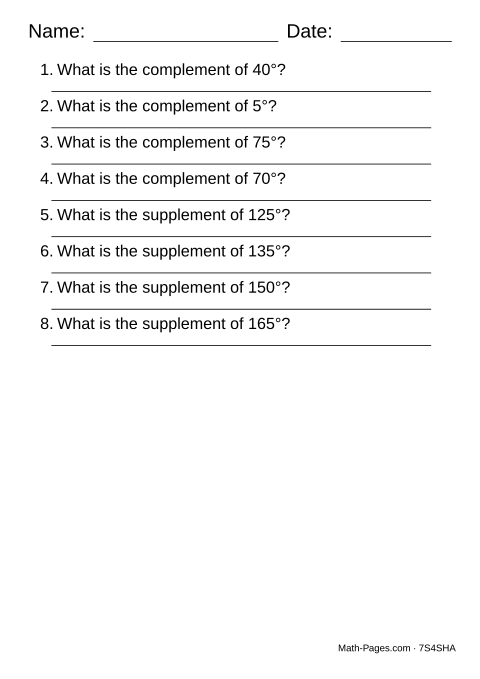
Two angles are complementary when they add to 90° and supplementary when they add to 180°. Each question gives one angle and asks for the other, mixing both kinds on the page so a student has to notice which is being asked.
Every question is built backwards from its answer, so the pair always completes exactly and no question ever answers 0° — the complement of 90° and the supplement of 180° are both nothing, and neither is worth printing.
What this worksheet covers
- Find the complement of an angle
- Find the supplement of an angle
Common Core standards
- 7.G.B.5 Use facts about supplementary, complementary and adjacent angles to find an unknown angle.
Frequently asked questions
What is the difference between complementary and supplementary?
Complementary angles add to 90°, a right angle. Supplementary angles add to 180°, a straight line. The usual way to keep them apart: C comes before S in the alphabet, and 90 comes before 180.
How do you find a complement or a supplement?
Subtract. The complement of 35° is 90 − 35 = 55°. The supplement of 80° is 180 − 80 = 100°. That is the whole method, which is why the difficulty lives in the numbers rather than the idea.
Can an obtuse angle have a complement?
No. An obtuse angle is already more than 90°, so there is nothing left to add. These sheets only ask for the complement of an acute angle, which is why every question has an answer.
What grade is this?
Seventh grade, 7.G.B.5, though the subtraction itself is well within reach earlier. Setting the angle step to 10° under Advanced options makes it a fourth or fifth grade sheet.