Finding the Hypotenuse Worksheets
Free printable hypotenuse worksheets: find the longest side of a right triangle from its two legs with the Pythagorean theorem. Whole-number answers and a key.
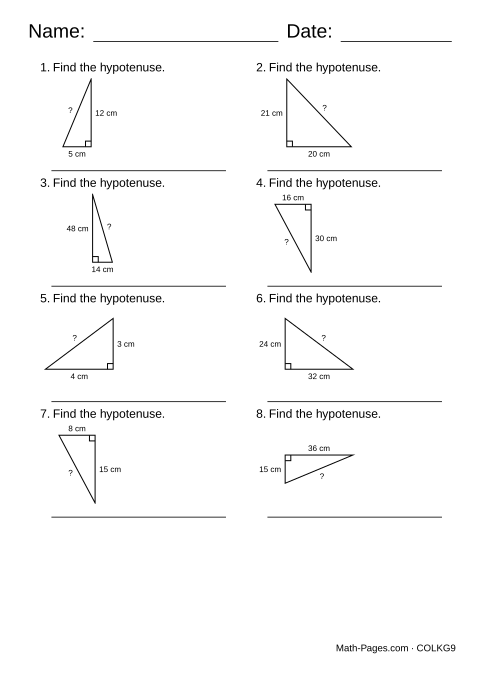
Each problem draws a right triangle with its two legs labelled in centimetres and the hypotenuse marked with a question mark, and asks for the hypotenuse: the side opposite the right angle. The right angle is marked with a small square and sits in any of the four corners, so the hypotenuse is not always the slanted side on the right.
To find the hypotenuse, square the two legs, add them, and take the square root of the total. Legs of 8 cm and 15 cm give 64 + 225 = 289, and 289 is 17 × 17, so the hypotenuse is 17 cm. The slip these sheets are built to catch is adding the legs themselves, 8 + 15 = 23, or stopping at 289.
Every triangle is a Pythagorean triple, 3-4-5, 5-12-13, 8-15-17, 7-24-25 or 20-21-29, or a whole-number multiple of one, so every answer is a whole number of centimetres. The hypotenuse is up to 50 cm by default, and the settings can move that limit to 25 or 100. Each triangle is drawn to the proportions of its labels, so a 7-24-25 triangle looks long and thin.
What this worksheet covers
- Pick out the hypotenuse as the side opposite the right angle
- Square the legs, add them and take the square root
- Find the hypotenuse of a right triangle from its two legs
Common Core standards
- 8.G.B.7 Apply the Pythagorean theorem to find unknown side lengths in right triangles.
Frequently asked questions
What is the hypotenuse?
The longest side of a right triangle. It sits opposite the right angle, and the two shorter sides, which meet at the right angle, are the legs.
What is the formula for the hypotenuse?
c² = a² + b², so the hypotenuse c is the square root of a² + b². For legs of 20 cm and 21 cm, 400 + 441 = 841, and 841 is 29 × 29, so the hypotenuse is 29 cm.
Why isn't the hypotenuse just the two legs added?
Because the straight way across is shorter than going round by both legs. Legs of 5 cm and 12 cm add to 17 cm, but the hypotenuse is 13 cm: 25 + 144 = 169, and 169 is 13 × 13.
Does it matter which leg is which?
No, because adding the squares gives the same total either way round. Legs of 7 cm and 24 cm give 49 + 576 = 625, and 625 is 25 × 25, so the hypotenuse is 25 cm whether the 7 is drawn flat or standing up. On these sheets either leg may be the flat one.