Scale Drawing Worksheets
Free printable scale drawing worksheets: find actual lengths and areas from a drawing's scale, and the lengths at a new scale. With an answer key.
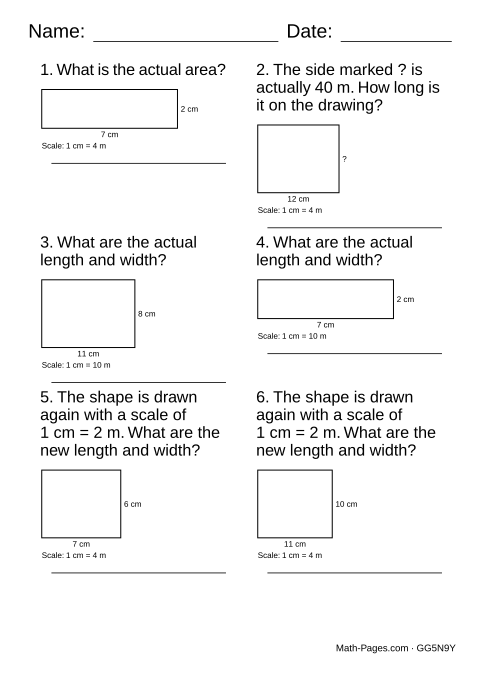
Each problem shows a rectangle drawn to scale, with its lengths in centimetres and the scale printed under it, such as Scale: 1 cm = 4 m. Each page deals four kinds of question as evenly as its count allows: the actual length and width, the actual area, the length of a side on the drawing, and the new lengths when the same shape is drawn at a different scale.
The scale is always 1 cm = 2, 3, 4, 5 or 10 m, so every actual length is a whole number of metres. A drawing's sides run from 2 cm to 12 cm, and a drawing is never a square, so its length and width are never the same answer. When a shape is redrawn at a new scale, the new scale always divides both actual lengths exactly, so the new lengths are whole centimetres.
There are no stories here, just the figure and its scale. The actual area is the question to watch: it is found from the actual lengths, because area scales by the scale twice.
What this worksheet covers
- Find actual lengths from a scale drawing and its scale
- Find the actual area of a rectangle from its scale drawing
- Find the lengths of a shape drawn at a different scale
Common Core standards
- 7.G.A.1 Solve problems involving scale drawings of geometric figures, including computing actual lengths and areas and reproducing a scale drawing at a different scale.
Frequently asked questions
How do you find the actual size from a scale drawing?
Multiply each length on the drawing by the scale. With Scale: 1 cm = 4 m, a side drawn 6 cm long is 6 × 4 = 24 m in real life and a side drawn 4 cm long is 4 × 4 = 16 m, so the real rectangle is 24 m by 16 m.
Why is the actual area not just the drawing's area times the scale?
Area multiplies two lengths, so the scale is applied twice. The drawing above has an area of 6 × 4 = 24 cm², and 24 × 4 = 96 is wrong. The actual area is 24 m × 16 m = 384 m², which is 24 × 16: the drawing's area times the scale squared.
How do you find a length on the drawing from the real length?
Divide by the scale. At 1 cm = 4 m, a real length of 20 m is 20 ÷ 4 = 5 cm on the drawing. Multiplying back, 5 × 4 = 20, checks the answer.
How do you redraw a shape at a different scale?
Find the actual lengths first, then divide each by the new scale. The 24 m by 16 m rectangle redrawn at 1 cm = 2 m is 24 ÷ 2 = 12 cm by 16 ÷ 2 = 8 cm. A smaller number of metres per centimetre makes the drawing bigger.