Area of a Circle Worksheets
Free printable area of a circle worksheets: find the space inside a circle from its radius or diameter, using 3.14 for pi. Answers in cm², with a key.
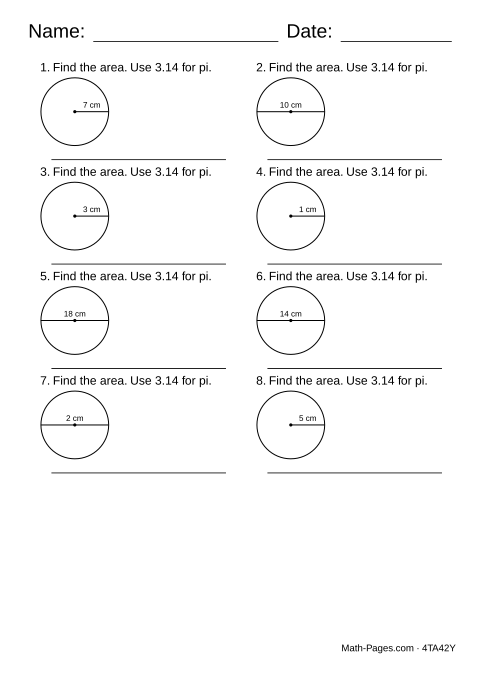
Each problem draws a circle with one line through it, labelled in centimetres, and asks for the area: the space inside the circle. The line is a radius, from the centre dot to the edge, on about half the circles, and a diameter, all the way across, on the rest. A diameter has to be halved before it is squared, which is the slip these sheets are built to catch. Every question says to use 3.14 for pi.
The area is pi times the radius times itself, A = 3.14 × r × r. A circle with a radius of 5 cm has an area of 3.14 × 5 × 5 = 78.5 cm². A circle labelled with a diameter of 10 cm has the same radius, 5 cm, and the same area. Using the 10 in place of the 5 gives 314 cm², four times too big.
Answers are in square centimetres, written cm², and have at most two decimal places. The radius is a whole number from 1 to 10 by default, and the settings can move the largest radius to 5 or 20. Every circle is drawn the same size, so the label gives the length, never the picture.
What this worksheet covers
- Find the area of a circle from its radius
- Find the area of a circle from its diameter by halving it first
- Use 3.14 for pi and give the answer in square centimetres
Common Core standards
- 7.G.B.4 Know the formulas for the area and circumference of a circle and use them to solve problems.
Frequently asked questions
What is the formula for the area of a circle?
A = pi × r × r: the radius multiplied by itself, then by pi. Using 3.14 for pi, a circle with a radius of 4 cm has an area of 3.14 × 4 × 4 = 50.24 cm².
What if the problem gives the diameter?
Halve it first to get the radius. A diameter of 12 cm means a radius of 6 cm, and the area is 3.14 × 6 × 6 = 113.04 cm².
Why is the area in cm²?
Because area counts unit squares, each 1 cm long and 1 cm wide. The radius is multiplied by itself, so its unit is too: cm × cm = cm².
Why is the radius squared, not the diameter?
The formula is built on the radius. Squaring the diameter instead makes the answer four times too big, because the diameter is twice the radius and 2 × 2 = 4. A circle with a diameter of 6 cm has an area of 3.14 × 3 × 3 = 28.26 cm², not 3.14 × 6 × 6 = 113.04 cm².