Area of Triangles Worksheets
Free printable area of triangles worksheets: the base, height and area of triangles drawn on a coordinate grid, two to a sheet, with an answer key.
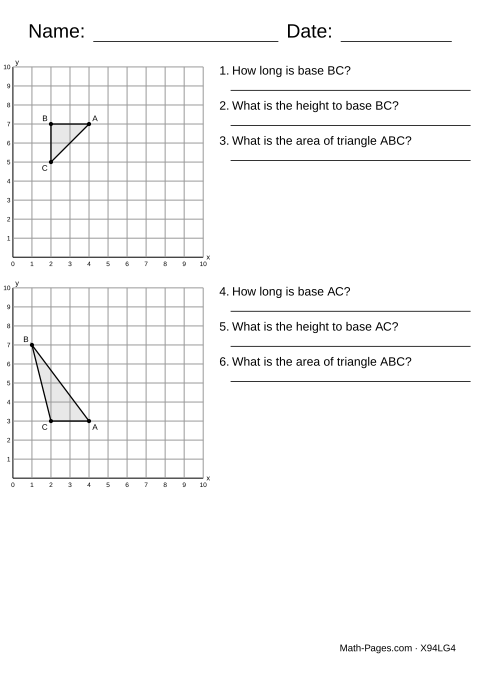
Each sheet draws two coordinate grids from 0 to 10 with a triangle on each. One side of every triangle, the base, lies along a gridline. Three questions sit beside each grid, in the order the formula uses them: how long the base is, the height to that base, and the area.
The height is the distance from the third corner straight across to the base's line, so it is read off the grid by subtracting two coordinates. The two triangles on a sheet are of different kinds, from three: one where the height is a side, as in a right triangle; one where it falls inside the triangle; and one where it falls outside, beyond the end of the base. The last is the one a sheet of right triangles never shows.
The area is half the base times the height, and every triangle is drawn so that this is a whole number of square units. No question asks for a slanted side, whose length needs the Pythagorean theorem. The grid can be switched to four quadrants in the settings.
What this worksheet covers
- Find the area of a triangle as half its base times its height
- Identify the height to a base, including when it falls outside the triangle
- Find a base and a height from coordinates on a grid
Common Core standards
- 6.G.A.1 Find the area of right triangles, special quadrilaterals and other polygons by composing them into rectangles or decomposing them into triangles and other shapes.
- 6.G.A.3 Draw polygons in the coordinate plane from the coordinates of their vertices, and use coordinates to find the length of a side joining points that share a coordinate.
Frequently asked questions
Why is the area of a triangle half the base times the height?
Two copies of any triangle fit together into a parallelogram with the same base and height, and a parallelogram's area is its base times its height, like the rectangle it can be cut and rearranged into. So one triangle is half of that. A triangle with a base of 6 and a height of 5 has an area of 15 square units.
Where is the height when it falls outside the triangle?
Extend the base's line past its end and measure straight across from the third corner to it. On a grid that is the difference of two coordinates: if the base runs along y = 2 and the third corner is at (9, 7), the height is 7 - 2 = 5 units, even though the corner is not above the base.
Does it matter which side is the base?
Any side can be the base, as long as the height is measured to that side. These sheets name the base in each question and always choose a side that runs along a gridline, so its height is read straight off the grid rather than measured at a slant.
Why are there no answers with halves?
Every triangle is drawn so that its base times its height is even, so half of it is a whole number. A half is a correct answer, and sixth graders can work with one, but whole numbers keep the practice on finding the height rather than on the division.