Area of Parallelograms Worksheets
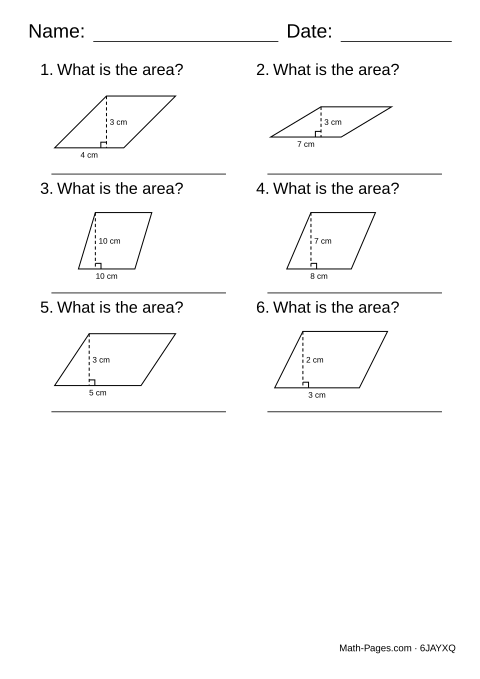
Free printable area of parallelograms worksheets. Each parallelogram is drawn to scale with its base and height labelled. Answers in cm², with a key.
Each question draws a parallelogram with its base and its height labelled, and asks for the area. The height is the dashed line, straight down from a top corner to the base, with a small square marking the right angle where they meet. Multiply the base by the height: a base of 8 cm and a height of 6 cm make 48 cm².
The slanted sides are drawn but never labelled, so the only two numbers on a shape are the two the formula uses. Every parallelogram leans - none is a rectangle - and each is drawn to scale. Bases and heights are 2 cm to 12 cm, so every area is a times-table fact.
What this worksheet covers
- Find the area of a parallelogram as its base times its height
- Tell the height of a parallelogram apart from its slanted side
Common Core standards
- 6.G.A.1 Find the area of right triangles, special quadrilaterals and other polygons by composing them into rectangles or decomposing them into triangles and other shapes.
Frequently asked questions
Why is the area of a parallelogram base times height?
Cut the triangle off one end along the height and slide it to the other end. The parallelogram becomes a rectangle with the same base and the same height, and so the same area: a base of 8 cm and a height of 6 cm make an 8 by 6 rectangle, which is 48 cm².
Why not multiply the base by the slanted side?
Because the slanted side is longer than the height, so the answer comes out too big. Area depends on how tall the shape stands, measured at right angles to the base. Leaning the same parallelogram further makes its slanted sides longer without changing its area at all.
Are the drawings to scale?
Yes. Each parallelogram is drawn at the proportions its labels state, lean included, so a student can see that the dashed height is shorter than the slanted side next to it.
What grade is the area of a parallelogram?
Sixth grade, where students find the areas of parallelograms, triangles and trapezoids by turning them into rectangles. It follows the area of a rectangle, which is third grade.