Area of Polygons Worksheets
Free printable area of polygons worksheets: parallelograms, triangles and trapezoids on one sheet, each with its base and height labelled. With an answer key.
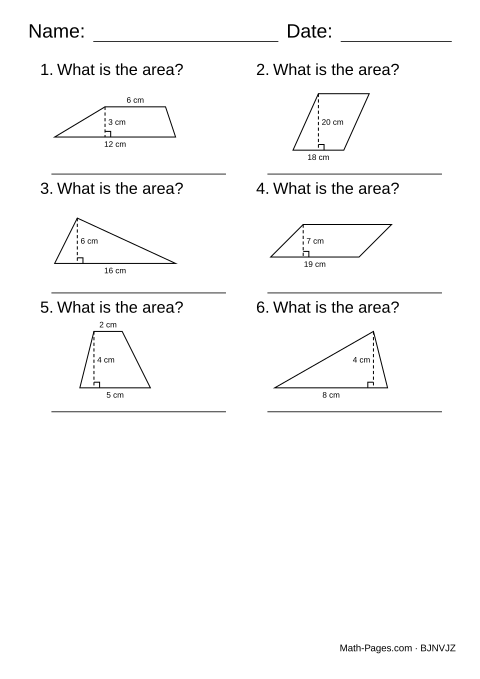
One sheet with the three shapes sixth grade finds the area of by formula: parallelograms (base × height), triangles (½ × base × height) and trapezoids (½ × the sum of the parallel sides × height). The three are dealt evenly, so a six-problem sheet has two of each.
Each shape is drawn to scale with only the numbers its formula needs - the base, the height as a dashed line, and for a trapezoid the top - so the student has to recognise which formula a shape calls for. Lengths go up to 20 cm, and every area is a whole number of cm². The polygons are these three shapes; figures made of several pieces are not on these sheets.
What this worksheet covers
- Find the area of parallelograms, triangles and trapezoids
- Choose the area formula that fits a shape
Common Core standards
- 6.G.A.1 Find the area of right triangles, special quadrilaterals and other polygons by composing them into rectangles or decomposing them into triangles and other shapes.
Frequently asked questions
Why mix the three shapes?
On a page of one shape the formula is decided before the first question is read. Mixed, the student has to look: a single top corner means a triangle, a top shorter than the base means a trapezoid, and a top as long as the base, shifted along, means a parallelogram.
How are the three formulas related?
All three come from the rectangle. A parallelogram rearranges into a rectangle, so its area is base × height. Two copies of a triangle make a parallelogram, so a triangle is half of that. Two copies of a trapezoid make a parallelogram whose base is both parallel sides, so a trapezoid is ½ × (a + b) × h.
Where are the triangles drawn on a grid?
On the area of triangles worksheets, which put each triangle on a coordinate grid and ask for its base and height as well as its area. The triangles here come with the base and height labelled, so the work is applying the formula.
What grade is this?
Sixth grade, where finding the area of triangles and special quadrilaterals is a standard of its own. With lengths up to 20 cm the products go past the times tables; set the longest side to 12 cm for smaller numbers.