Pythagorean Theorem Worksheets
Free printable Pythagorean theorem worksheets: find the hypotenuse, find a missing leg, and test whether three sides make a right triangle. With an answer key.
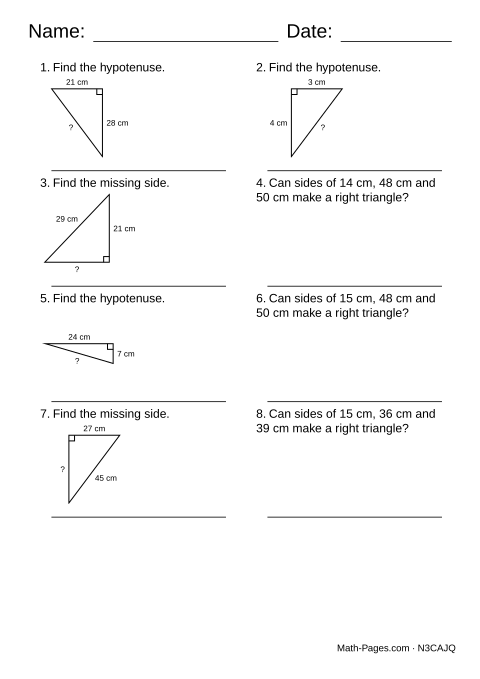
Each problem is about a right triangle, with every length in centimetres, and asks one of three questions. Find the hypotenuse from the two legs. Find a missing leg when the hypotenuse and the other leg are given. Or, with no drawing, decide whether three lengths could be the sides of a right triangle.
The theorem is a² + b² = c², where c is the hypotenuse. A triangle with legs of 5 cm and 12 cm has 25 + 144 = 169, so its hypotenuse is 13 cm. A missing leg runs it backwards: with a hypotenuse of 13 cm and a leg of 5 cm, 169 − 25 = 144, so the other leg is 12 cm. The slip these sheets are built to catch is adding the squares when the problem needs them subtracted.
Every set of sides is a Pythagorean triple, such as 3-4-5, 5-12-13, 8-15-17, 7-24-25 or 20-21-29, or a whole-number multiple of one, so every answer is a whole number of centimetres. The longest side is up to 50 cm by default, and the settings can move it to 25 or 100. The right angle, marked with a small square, sits in any of the four corners, so the hypotenuse is not always the slanted side on the right. Each sheet deals the three questions as evenly as the count allows, and splits the right-triangle questions between yes and no, with the check shown in the key.
What this worksheet covers
- Find the hypotenuse of a right triangle from its legs
- Find a missing leg from the hypotenuse and the other leg
- Decide whether three side lengths make a right triangle
Common Core standards
- 8.G.B.7 Apply the Pythagorean theorem to find unknown side lengths in right triangles.
Frequently asked questions
What is the Pythagorean theorem?
In a right triangle, the squares of the two legs add up to the square of the hypotenuse: a² + b² = c². A triangle with legs of 6 cm and 8 cm has 36 + 64 = 100, and 100 is 10 × 10, so its hypotenuse is 10 cm.
How do you find a missing leg?
Subtract instead of add: the missing leg squared is the hypotenuse squared minus the other leg squared. With a hypotenuse of 17 cm and a leg of 8 cm, 289 − 64 = 225, and 225 is 15 × 15, so the missing leg is 15 cm.
How can you tell whether three lengths make a right triangle?
Square all three, add the two smaller squares, and compare the total with the square of the longest. For 9, 12 and 15, 81 + 144 = 225 and 15 × 15 = 225, so it is a right triangle. For 6, 8 and 11, 36 + 64 = 100 but 11 × 11 = 121, so it is not.
Which side is the hypotenuse?
The side opposite the right angle, which is marked with a small square. It is always the longest side of the triangle. On these sheets the right angle sits in any of the four corners, so look for the square rather than for the slanted side.