Circle Worksheets
Free printable circle worksheets: find the circumference and area of a circle, or the diameter from the circumference, using 3.14 for pi. With an answer key.
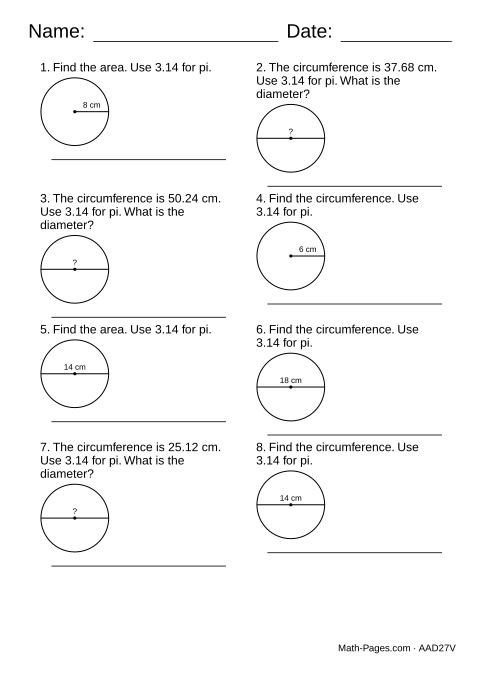
Each problem draws a circle with one line through it, labelled in centimetres, and asks one of three questions. Find the circumference, the distance around. Find the area, the space inside. Or work backwards: the circumference is given in the question, the diameter is marked with a question mark, and the student finds it. Every question says to use 3.14 for pi.
Mixing them is the point of seventh-grade circles: which formula, and which length goes into it? A circle with a radius of 5 cm has a diameter of 10 cm, a circumference of 3.14 × 10 = 31.4 cm and an area of 3.14 × 5 × 5 = 78.5 cm². Going back, a circumference of 31.4 cm divided by 3.14 is a diameter of 10 cm, so the diameter question always comes out as a whole number.
Each sheet deals the three questions as evenly as the count allows. The radius is a whole number from 1 to 10 by default, the settings can move the largest radius to 5 or 20, and a diameter on the page is always twice a radius, so it is even. Every circle is drawn the same size, so the label gives the length, never the picture.
What this worksheet covers
- Find the circumference of a circle from its radius or diameter
- Find the area of a circle, halving a diameter first
- Find the diameter of a circle from its circumference
Common Core standards
- 7.G.B.4 Know the formulas for the area and circumference of a circle and use them to solve problems.
Frequently asked questions
How do you know whether to find the circumference or the area?
Circumference is a length, the distance around, so it is in cm. Area is the space inside, so it is in cm². A circle with a diameter of 6 cm has a circumference of 3.14 × 6 = 18.84 cm and, with a radius of 3 cm, an area of 3.14 × 3 × 3 = 28.26 cm².
How do you find the diameter from the circumference?
Divide by 3.14, because C = 3.14 × d. If the circumference is 62.8 cm, the diameter is 62.8 ÷ 3.14 = 20 cm, and the radius is half of that, 10 cm.
What is the difference between a radius and a diameter?
A radius runs from the centre of the circle to its edge. A diameter runs from edge to edge through the centre, so it is twice as long. On these sheets a radius is drawn from the centre dot to the edge and a diameter goes right across through the dot, with the length written above the line.
What grade learns the circumference and area of a circle?
Seventh grade, in standard 7.G.B.4: know the formulas for the area and circumference of a circle and use them to solve problems. The standard also asks for an informal explanation of how the area and the circumference are related, which is reasoning to talk through rather than a question with an answer to check, so it is not on these sheets.