Volume with Unit Cubes
Free printable volume worksheets: count the unit cubes that fill each box, with every cube edge drawn. Up to 5 cubes on a side, with an answer key.
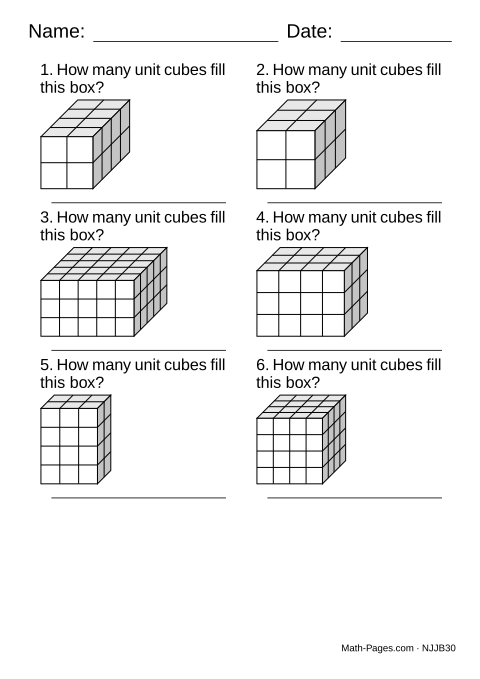
Volume starts with cubes. Each problem draws a box built from unit cubes, with every cube edge on its front, top and side drawn in, and asks how many unit cubes fill it. Because the cubes fill the box, the ones that are out of sight count too.
Counting one at a time only reaches the cubes on the outside. The way through is by layers: a box 3 cubes long and 2 deep has 6 cubes in its bottom layer, and if it is 4 cubes high it has 4 layers, 24 cubes in all. Every edge is between 2 and 5 cubes, so no box holds more than 125.
When counting by layers is secure, the volume worksheets label the edges in centimetres and ask for the volume as length × width × height.
What this worksheet covers
- Count the unit cubes that fill a rectangular prism
- Find a volume as the cubes in one layer times the number of layers
Common Core standards
- 5.MD.C.3 Recognize volume as an attribute of solid figures, measured in unit cubes.
- 5.MD.C.4 Measure volumes by counting unit cubes.
Frequently asked questions
What is a unit cube?
A cube whose edges are each one unit long. It is what volume is measured in, the way a unit square is what area is measured in: a box that 24 unit cubes fill exactly has a volume of 24 cubic units.
How do you count the cubes you can't see?
Count one layer and multiply. The front shows how many cubes long and how many high the box is, and the top shows how many deep. A box 3 long, 2 deep and 4 high has 3 × 2 = 6 cubes in each layer and 4 layers, so 24 cubes.
Why does every question ask what fills the box?
So the picture has one answer. A drawing shows only three faces, and a box could be hollow behind them. Asking how many cubes fill the box means the hidden ones count.
Why is no box more than 5 cubes on a side?
So the cubes stay big enough to count on paper, and no total is over 125. Larger boxes belong on the volume worksheets, where the edges are labelled and the volume is multiplied.