Volume of Cylinders, Cones and Spheres
Free printable volume worksheets mixing cylinders, cones and spheres: pick the right formula, use 3.14 for pi, and check every answer with the key.
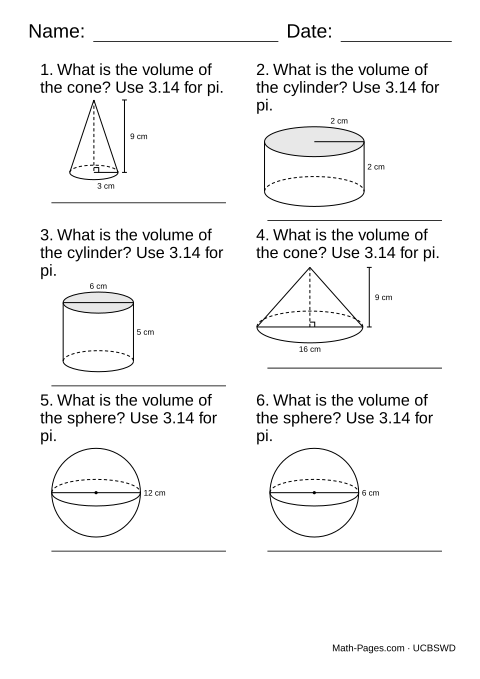
Every sheet mixes the three round solids of eighth grade, about a third of each. Each problem draws a cylinder, a cone or a sphere, labels its radius or its diameter, and its height when it has one, and asks for the volume, using 3.14 for pi.
The three formulas are close relatives. A cylinder is 3.14 × r² × h. A cone with the same base and height is one third of that. A sphere has no height, only a radius, and is four thirds of 3.14 × r³. Choosing the right one for each drawing, and halving each diameter, is the work of the sheet.
Radii and heights are whole centimetres from 2 to 10. Each cone has a radius or a height that is a multiple of 3, and each sphere a radius of 3, 6 or 9 cm, so every answer comes out exact, with at most two decimal places.
What this worksheet covers
- Find the volumes of cylinders, cones and spheres
- Choose the volume formula that fits each solid
- Halve a diameter to find the radius
Common Core standards
- 8.G.C.9 Know the formulas for the volumes of cones, cylinders, and spheres and use them to solve problems.
Frequently asked questions
How do you tell the three formulas apart?
Start from the cylinder, 3.14 × r² × h, the base times the height. A cone is a cylinder that narrows to a point, and holds a third of it. A sphere has no flat base and no height, so its formula uses the radius alone: four thirds of 3.14 × r³.
How do a cylinder, a cone and a sphere of the same size compare?
Take a cylinder with a radius of 3 cm and a height of 6 cm: its volume is 3.14 × 9 × 6 = 169.56 cm³. A cone with the same base and height holds a third of it, 56.52 cm³. A sphere with a radius of 3 cm fits exactly inside the cylinder and holds 113.04 cm³, two thirds of it. The cone and the sphere together hold exactly what the cylinder does: 56.52 + 113.04 = 169.56.
Why does every answer stop at two decimal places?
Because 3.14 has two, and the whole numbers it is multiplied by add none. The thirds in the cone and sphere formulas would make answers like 20.9333… with no end, so on these sheets a cone always has a radius or a height that divides by 3, and a sphere always has a radius that does.
What grade is this?
Eighth grade, and it is the last volume standard before high school. It comes after the volume of a box in fifth grade and the area of a circle in seventh. The pages for cylinders, cones and spheres on their own practise one formula at a time.