Volume of Spheres
Free printable volume of spheres worksheets: four thirds of 3.14 × r³, from a labelled radius or diameter. Exact decimal answers, with an answer key.
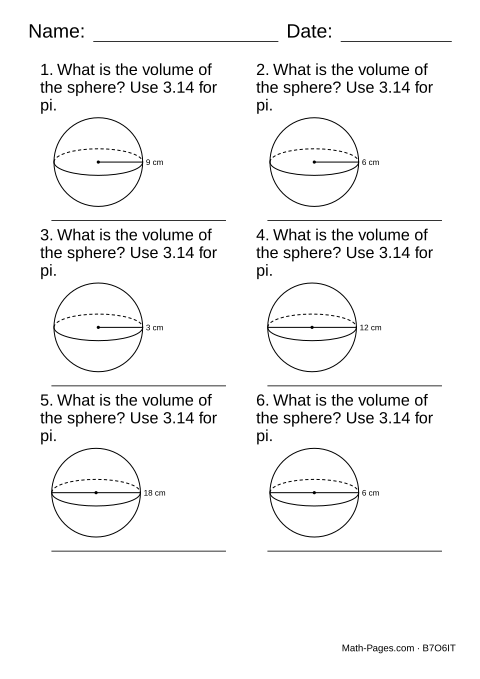
Each problem draws a sphere, a ball, with its equator drawn round the middle and its radius or its diameter labelled, and asks for the volume. The student uses 3.14 for pi.
The volume of a sphere is four thirds of 3.14 × r³: the radius is multiplied by itself three times. A sphere with a radius of 3 cm has r³ = 27, four thirds of 27 is 36, and 3.14 × 36 = 113.04 cm³. When a problem gives the diameter, halve it first.
Every radius on these sheets is 3, 6 or 9 cm, so every diameter is 6, 12 or 18 cm. A multiple of 3 is what lets the four thirds come out exactly, and every answer has at most two decimal places. Setting the largest radius to 12 in the settings adds spheres with a radius of 12 cm.
What this worksheet covers
- Find the volume of a sphere from its radius or diameter
- Cube the radius and multiply by four thirds of 3.14
Common Core standards
- 8.G.C.9 Know the formulas for the volumes of cones, cylinders, and spheres and use them to solve problems.
Frequently asked questions
How do you find the volume of a sphere?
Cube the radius, multiply by 4 and divide by 3, then multiply by 3.14: V = ⁴⁄₃πr³. A sphere with a radius of 6 cm has r³ = 216, four thirds of that is 288, and 3.14 × 288 = 904.32 cm³.
What if the diameter is given?
Halve it to get the radius. A sphere with a diameter of 18 cm has a radius of 9 cm, so r³ = 729, four thirds of that is 972, and the volume is 3.14 × 972 = 3,052.08 cm³. Using 18 as the radius gives eight times too much, because doubling a length that is multiplied three times doubles the answer three times.
Why is the radius cubed?
Because volume is measured in cubes, so it is always three lengths multiplied together. A box multiplies a length, a width and a height. A sphere has only one length, its radius, so the radius is used three times, and the answer is in cm³.
How does a sphere compare with a cylinder?
A sphere fills two thirds of the smallest cylinder that holds it, one with the same radius and a height equal to its diameter. For a radius of 3 cm, that cylinder is 3.14 × 9 × 6 = 169.56 cm³, and two thirds of 169.56 is 113.04 cm³, the volume of the sphere. Archimedes, who found it, asked for a sphere inside a cylinder to be carved on his tomb.