Find the Missing Angle
Free printable missing angle worksheets: the third angle of a triangle, angles on a straight line, and angles around a point. With an answer key.
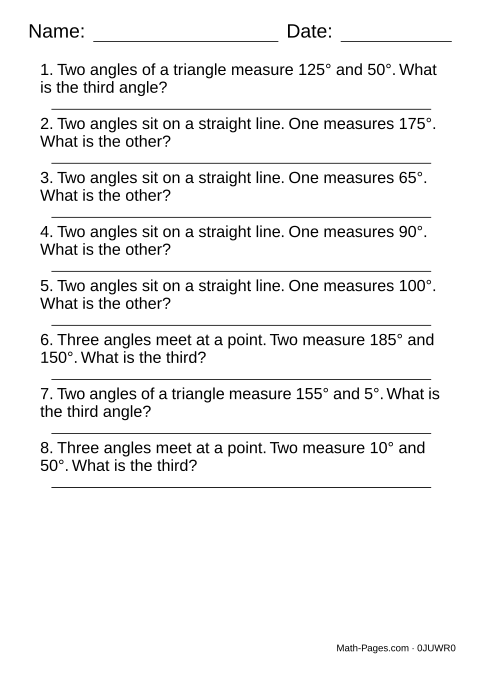
Three situations, mixed on one page: the third angle of a triangle when two are known, the second of two angles on a straight line, and the third of three angles meeting at a point. They rest on three facts — a triangle’s angles add to 180°, a straight line is 180°, and a full turn is 360°.
Every question is assembled from its parts rather than drawn and then checked, so the angles always add up exactly and no missing angle is ever 0°.
What this worksheet covers
- Find a missing angle in a triangle
- Find missing angles on a straight line and around a point
Common Core standards
- 7.G.B.5 Use facts about supplementary, complementary and adjacent angles to find an unknown angle.
- 8.G.A.5 Use facts about the angle sum of a triangle to reason about unknown angles.
Frequently asked questions
Why do a triangle’s angles add to 180°?
Tear the three corners off a paper triangle and lay them side by side: they form a straight line. That is the fact these questions use, and it holds for every triangle.
How do you find the third angle of a triangle?
Add the two you were given and subtract from 180. If two angles are 85° and 10°, the third is 180 − 95 = 85°.
What is the difference between angles on a line and around a point?
Angles on a straight line add to 180°, half a turn. Angles around a point add to 360°, a full turn. The sheet mixes both so a student has to read which one is being asked.
What grade is finding a missing angle?
Fourth grade for adding and subtracting angles (4.MD.C.7); eighth grade for the triangle angle sum as a rule (8.G.A.5). Setting the angle step to 10° keeps the arithmetic easy while the idea is new.