Polygons on the Coordinate Plane Worksheets
Free printable polygons on the coordinate plane worksheets: area, perimeter and side lengths of rectangles and L-shapes on four-quadrant grids, with a key.
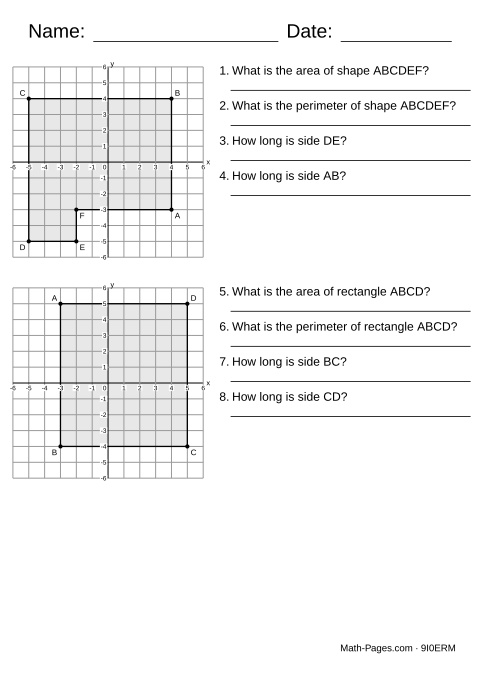
Each sheet draws two coordinate grids from -6 to 6 with a shape on each: one rectangle, and one L-shape, which is a rectangle with a corner cut away. The corners are lettered in order around the shape. Four questions sit beside each grid: the shape's area, its perimeter, and the lengths of two of its sides, one across and one up and down.
Every side runs along a gridline, so its length is the difference of two coordinates. From (-4, -2) to (-4, 3) is 5 units: the first corner is 2 below the x-axis and the second 3 above it, which is the absolute value step of sixth grade. Corners sit on labelled crossings and never on an axis, so each coordinate is read straight off the numbers.
An L-shape's area takes one more step: split it into two rectangles along a gridline and add them, or take the rectangle around it and subtract the missing corner. Its perimeter is the same as that rectangle's. No question asks a student to draw a shape; the shapes are drawn, and the questions read them.
What this worksheet covers
- Find the length of a side from the coordinates of its endpoints
- Find the perimeter of a rectangle or L-shape on the coordinate plane
- Find the area of an L-shape by splitting it into rectangles
Common Core standards
- 6.G.A.3 Draw polygons in the coordinate plane from the coordinates of their vertices, and use coordinates to find the length of a side joining points that share a coordinate.
- 6.G.A.1 Find the area of right triangles, special quadrilaterals and other polygons by composing them into rectangles or decomposing them into triangles and other shapes.
Frequently asked questions
How do you find the length of a side from coordinates?
Look at which coordinate the two corners share. If they share an x-coordinate, the side runs up and down, and its length is the difference of the y-coordinates; if they share a y-coordinate, subtract the x-coordinates. When a side crosses an axis, add the two distances to it: from (3, -5) to (3, 2) is 5 + 2 = 7 units.
How do you find the area of an L-shape?
Split it into two rectangles with one cut along a gridline, find each area, and add them. Or take the rectangle that just fits around it and subtract the corner that is missing. An L-shape inside a 6 by 5 rectangle with a 2 by 3 corner cut away has an area of 30 - 6 = 24 square units.
Why is an L-shape's perimeter the same as its rectangle's?
The two sides that step in at the missing corner are as long as the two sides they replace: one runs across as far as the corner is wide, the other up and down as far as it is tall. An L-shape inside a 6 by 5 rectangle has a perimeter of 22 units, whichever corner is cut away.
Why are there no triangles?
A triangle on a grid has at least one slanted side, and the length of a slanted side needs the Pythagorean theorem, which is eighth grade and rarely gives a whole number. Every side on these sheets runs along a gridline, so every length, perimeter and area is a whole number worked out from the coordinates.