Area and Perimeter Worksheets
Free printable area and perimeter worksheets. Labelled rectangles drawn to scale, with an answer key. Includes finding a missing side.
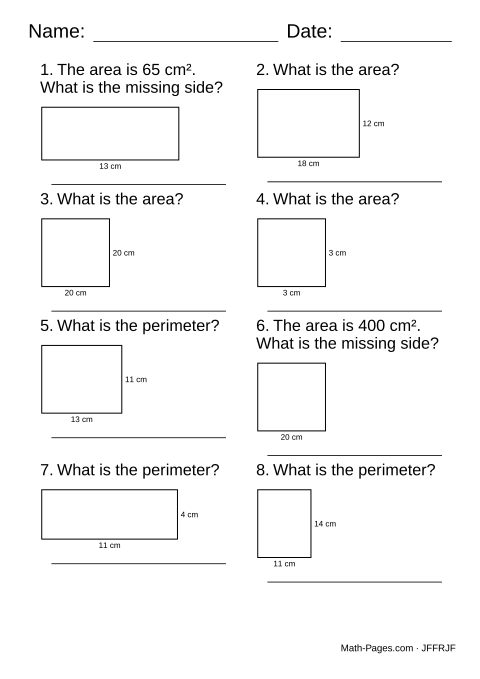
Each problem shows a rectangle with its sides labelled and asks for the perimeter, the area, or a missing side. Answers carry their units - centimetres for a perimeter, square centimetres for an area - because the unit is half of what this topic teaches.
Every rectangle is drawn at the proportions it is labelled with. A shape marked 8 cm by 4 cm really is twice as wide as it is tall. Most worksheets print "not to scale" and draw whatever fits; that misleads a child who trusts the picture, so these sheets simply do not generate a shape they cannot draw truthfully.
What this worksheet covers
- Find the perimeter and area of a rectangle
- Find a missing side from the area or perimeter
- Write answers with the correct units
Common Core standards
- 4.MD.A.3 Apply the area and perimeter formulas for rectangles.
Frequently asked questions
What is the difference between area and perimeter?
Perimeter is the distance round the outside; area is the space inside. A 8 by 4 rectangle has a perimeter of 24 cm and an area of 32 cm² - the same shape, two different measurements, and two different units.
How do you find the area of a rectangle?
Multiply the two sides. 8 × 4 is 32, so the area is 32 cm². Perimeter is the two sides added and doubled: 2 × (8 + 4) is 24 cm.
Why does the answer need a unit?
Because 32 on its own does not say whether it is a length or an area. Square centimetres and centimetres are different things, and getting that right is the part of this topic students most often lose marks on.
What grade is area and perimeter?
Third grade introduces area, fourth adds perimeter and the two together, and fifth works with missing sides.