Volume of Composite Figures
Free printable composite volume worksheets: two boxes joined in a step, every edge labelled. Add the two volumes for the total in cm³, with a key.
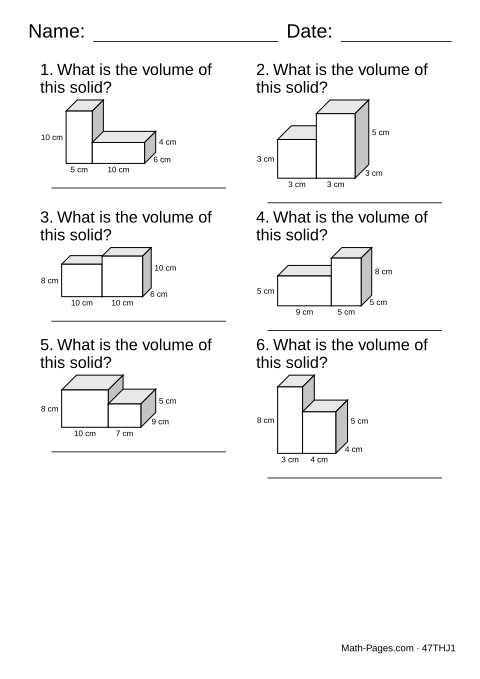
Each problem draws a solid made of two boxes side by side, one taller than the other, like a step. The line where the two boxes meet is drawn, and every edge the child needs is labelled: each box's width and height, and the depth they share. The child finds the volume of each box and adds them.
That is what fifth grade means by volume being additive. A step whose left box is 4 cm wide and 6 cm high, whose right box is 3 cm wide and 2 cm high, and whose depth is 5 cm holds 4 × 5 × 6 = 120 cm³ on the left and 3 × 5 × 2 = 30 cm³ on the right, 150 cm³ in all.
Every edge is a whole number of centimetres up to 10, and the two heights always differ by at least 2 cm, so the step is plain to see. For single boxes, and for counting cubes, use the volume worksheets.
What this worksheet covers
- Find the volume of a solid made of two boxes by adding their volumes
- Find each box's volume from its width, depth and height
Common Core standards
- 5.MD.C.5c Find the volume of a solid made of two non-overlapping rectangular prisms by adding the volumes of the parts.
Frequently asked questions
What is a composite figure in volume?
A solid made of simpler solids joined together. On this sheet it is always two rectangular boxes side by side, so its volume is the volume of one box plus the volume of the other.
How do you find the volume of two boxes joined together?
Find the volume of each box and add them. If the left box is 5 cm by 4 cm by 3 cm and the right box is 2 cm by 4 cm by 6 cm, the volumes are 60 cm³ and 48 cm³, so the solid is 108 cm³.
Why is the line between the two boxes drawn?
So the solid is split the way its labels describe. A step can also be cut across instead of down, and the total comes out the same, but then some lengths would have to be worked out by subtracting. That harder version is not on this sheet.
What grade is this for?
Fifth grade, where volume is first shown to add up: a solid made of two boxes holds the volume of one plus the volume of the other. It comes after finding the volume of a single box.